


The global hospitality technology industry could be heading toward one of its most disruptive periods as artificial intelligence giants increasingly develop capabilities that threaten the traditional business models of hotel technology providers and online travel agencies (OTAs). Companies such as Google, OpenAI, Anthropic and Microsoft are expanding their AI ecosystems, potentially transforming how hotels manage operations, distribute room inventory, attract customers and generate direct reservations.
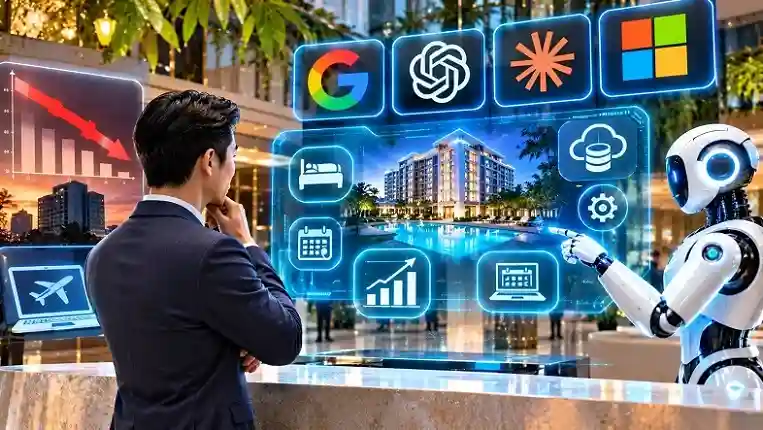
Image Credit: Bangkok Hotel News
For years, hotels have depended on numerous third-party technology providers, often paying substantial subscription fees, integration costs and booking commissions. However, as this Bangkok Hotel Technology news report examines, the emergence of autonomous AI agents and increasingly sophisticated enterprise platforms could fundamentally alter these commercial relationships, with significant disruption potentially gathering momentum from late 2027 onward.
Hotel Technology Exhibition Highlights an Industry Facing Change
The recently concluded NoVacancy Asia 2026 exhibition, held from November 24th to 25th at Bangkok’s Queen Sirikit National Convention Center, showcased the enormous commercial ecosystem that has developed around hospitality technology.
Promoted with claims as an event that brought together more than 3,000 attendees, 150 exhibitors and sponsors, and 170 speakers, the exhibition covered everything from property management systems and revenue optimization to robotics, automated guest communications, payment processing and digital marketing.
However, many of these technology segments are increasingly exposed to competition from general-purpose artificial intelligence platforms capable of integrating multiple commercial functions within a single environment, at a fraction of a price that these current companies are charging their existing hotel customers.
Google Has Already Entered AI-Powered Hotel Bookings
The threat to conventional hotel distribution businesses is no longer entirely theoretical. Google has already introduced agentic hotel booking capabilities through its AI Mode in the United States, allowing eligible travelers to search for accommodation, compare rooms, review reservation conditions and complete bookings without leaving Google’s interface.
Payments can be completed using Google Pay, while participating merchants remain responsible for reservation confirmations, cancellations and customer support.
Google has also been developing its Universal Commerce Protocol, which could facilitate transactions between AI assistants and participating businesses. Major hospitality groups, online travel agencies and travel infrastructure providers are already collaborating with Google.
The development potentially places Google in an extraordinarily powerful position within the hotel distribution ecosystem, controlling the initial search, accommodation discovery and booking interface.
Hotels that eventually establish direct connectivity with such platforms could become less dependent on conventional intermediaries.
OpenAI, Anthropic and Microsoft Could Reshape Hotel Operations
OpenAI has already integrated Booking.com and Expedia applications into ChatGPT, allowing travelers to discover accommodation through conversational interfaces rather than conventional website searches. Its development tools also enable businesses to create applications that connect directly with their customers through ChatGPT.
Meanwhile, Anthropic’s Model Context Protocol (MCP) provides a standardized mechanism for connecting AI applications with external software, databases and business systems.
Microsoft’s Copilot Studio already enables enterprises to develop customized autonomous agents capable of performing business tasks, accessing databases and coordinating multiple operational workflows.
Chinese technology companies, including Alibaba, Huawei, Zhipu AI and Moonshot AI, represent another emerging source of competition, particularly for hospitality markets across Asia.
Hotel Channel Managers and Revenue Platforms Face Growing Competition
Companies such as SiteMinder have built substantial businesses around solving the complexities of hotel distribution.
SiteMinder enables accommodation providers to synchronize room availability, reservations and pricing across numerous booking channels. Its broader portfolio encompasses direct booking engines, website development, market intelligence, revenue optimization, payment processing and guest engagement.
The company also participated in NoVacancy Asia 2026, promoting its distribution and revenue management platform.
However, as AI agents become capable of communicating directly with reservation databases, analyzing competitor pricing, forecasting demand and automating inventory distribution, the commercial landscape could change dramatically.
Rather than maintaining multiple software subscriptions, hotels could eventually commission customized AI-powered systems that handle numerous operational functions simultaneously.
Nevertheless, replacing established platforms will require reliable real-time synchronization, cybersecurity safeguards, payment compliance and integration with existing hotel infrastructure.
Online Travel Agencies Face a Battle for Survival
OTAs could face considerable pressure if travelers increasingly rely on AI assistants to discover accommodation, compare prices and make reservations.
For independent hotels in Bangkok, Phuket, Pattaya and other major tourism destinations, direct AI-driven bookings could potentially reduce commission expenses and improve profitability.
However, established OTAs are not standing still. Booking.com has already collaborated extensively with OpenAI to develop intelligent travel planning, personalized searches, automated guest communications and review summaries.
The emerging competition is therefore likely to revolve around ownership of customer relationships, access to real-time inventory, transaction costs and control over digital distribution.
AI companies could effectively become a new generation of intermediaries rather than eliminating intermediaries altogether.
Could Late 2027 Mark the Beginning of a Major Industry Shakeout?
Further advances in autonomous enterprise software during 2027 could accelerate consolidation across the hospitality technology sector.
Businesses specializing in relatively straightforward automation, guest messaging, website management, marketing content and basic analytical services may face particularly intense pricing pressure.
According to enterprise business development directors at Open AI and Goggle and product development specialist at these companies, a variety of products targeting the hotel industry will be making their debuts between the second and third quarter of 2027.
A Dramatically Different Future for Hospitality Technology
The hospitality technology industry is approaching a potentially historic transformation. Companies charging substantial fees for fragmented services could find themselves increasingly vulnerable as affordable, integrated AI alternatives emerge. While established technology providers and OTAs with strong infrastructure, proprietary data and customer networks may successfully adapt, others could face declining revenues, consolidation or eventual closure. For hoteliers, the coming years could bring unprecedented opportunities to reduce operating expenses, strengthen direct customer relationships and regain greater control over distribution.