


Speculation is gathering momentum across Bangkok’s hospitality and real estate sectors over the possible location of the newly announced JW Marriott Bangkok Sathorn. Although Marriott International and its Thai development partner, FICO Corporation, have yet to disclose the property’s exact address, attention is increasingly turning toward a long-shuttered residential landmark in one of the capital’s most desirable neighborhoods. The former Pantip Court, subsequently known as Pantip Suites Sathorn, on Sathorn Soi 1 has emerged as a possible candidate for the ambitious luxury hotel development.
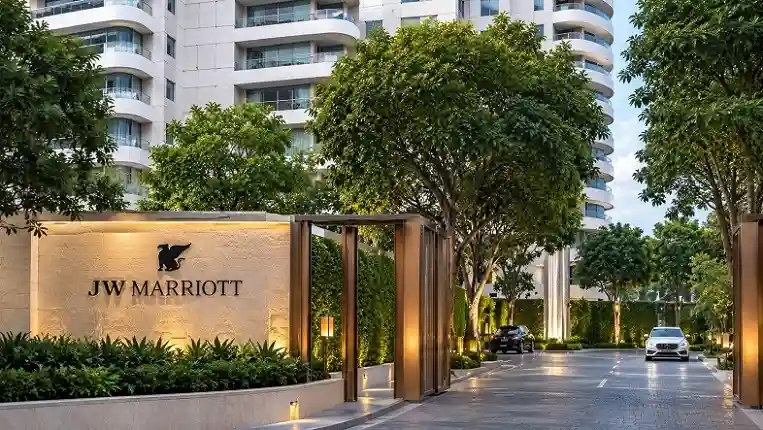
Image Credit: Marriott
The speculation follows the announcement of a major hospitality expansion agreement between Marriott International and FICO Corporation in October 2026. Under the arrangement, seven hotels are planned across Thailand, with the proposed 288-room JW Marriott Bangkok Sathorn standing out as one of the most significant projects. As interest in the development continues to grow, this Bangkok Hotel News report examines the architectural clues, property history, and redevelopment possibilities that have placed the former Pantip Court firmly in the spotlight. While the circumstantial evidence offers an intriguing picture, the precise location of the hotel remains unconfirmed.
A Familiar Sathorn Landmark Attracts Renewed Attention
Located at 68 Soi Sathorn 1, also known as Soi Attakarnprasit, the former Pantip Court occupies a well-established position within Bangkok’s prestigious Sathorn district. The 28-story building, originally completed in 1997, was developed by Pantip Park Co., Ltd., a company associated with the Panichewa family.
For years, the property operated as an upscale serviced apartment residence, catering to expatriates, corporate executives, and long-stay visitors seeking spacious accommodations close to Bangkok’s central business district.
The building later became known as Pantip Suites Sathorn, maintaining its reputation for exceptionally generous apartment sizes and a relatively peaceful setting despite its proximity to the busy Sathorn commercial corridor.
However, the property eventually ceased operations and has remained closed for several years. Renovation barriers surrounding the premises have contributed to questions about its future, particularly as Bangkok’s luxury hospitality market continues to attract substantial investment.
The possibility that this established high-rise could be transformed into a JW Marriott has consequently become a subject of interest among property observers familiar with the neighborhood.
Architectural Renderings Provide an Intriguing Clue
One of the more interesting elements behind the speculation involves the architectural renderings associated with the announced JW Marriott Bangkok Sathorn.
Images released in connection with the project depict a sophisticated arrival experience, incorporating landscaped grounds, an attractive driveway, and cascading water features intended to create a sense of tranquility within the bustling city.
Observers have drawn comparisons between these design elements and the physical characteristics of the former Pantip Court property.
Unlike many commercial buildings situated directly along Bangkok’s heavily trafficked main roads, the Sathorn Soi 1 site benefits from a more secluded setting that could potentially accommodate the landscaped entrance and resort-inspired atmosphere envisioned for the new hotel.
The property’s established high-rise configuration also makes it an interesting candidate for redevelopment rather than an entirely new construction project.
Nevertheless, architectural similarities alone cannot establish that the two properties are connected. Hotel renderings frequently illustrate conceptual designs that may differ substantially from the final development, and no publicly confirmed site plan has yet linked the announced JW Marriott to the former Pantip Court.
The Room Numbers Add Another Layer to the Speculation
Perhaps the most compelling aspect of the discussion concerns the building’s original accommodation layout.
Pantip Court was developed with approximately 148 serviced apartments, consisting primarily of expansive one- and two-bedroom units measuring between 97 and 162 square meters.
These unusually large residential spaces offer an interesting redevelopment possibility.
If a developer were to reconfigure the apartments into smaller luxury hotel rooms and suites, the resulting accommodation inventory could potentially approach the 288 rooms announced for JW Marriott Bangkok Sathorn.
The numerical relationship is particularly noteworthy because dividing 148 large residential units into approximately two hotel rooms each would produce 296 rooms, a figure close to the proposed hotel’s inventory.
Of course, an actual conversion would require substantially more sophisticated planning. Existing structural columns, plumbing systems, elevators, fire safety provisions, service corridors, and building regulations would all influence the number of rooms that could realistically be created.
Space would also be required for restaurants, meeting facilities, wellness amenities, and other public areas expected of an internationally branded luxury hotel.
Even so, the building’s original dimensions and generous residential floor plans suggest that a comprehensive hospitality conversion could be technically worth investigating.
The apparent compatibility between the existing apartment count and Marriott’s proposed room inventory remains circumstantial rather than documentary evidence of a confirmed redevelopment.
A $57 Million Investment Could Support an Ambitious Transformation
The JW Marriott Bangkok Sathorn project has been associated with an estimated investment of approximately US$57 million, positioning it as a substantial component of the broader Marriott–FICO expansion agreement.
Such an investment could support a major luxury hotel development, although the allocation of funds between property acquisition, construction, renovation, interior design, and operating infrastructure has not been publicly detailed.
If the former Pantip Court were ultimately selected, the development would potentially involve an extensive modernization of a building approaching three decades in age.
Transforming a serviced apartment tower into a contemporary JW Marriott would require far more than cosmetic improvements.
A luxury hotel conversion would likely involve redesigned guestrooms, upgraded mechanical and electrical systems, modernized elevators, enhanced fire protection, improved accessibility, and new hospitality facilities.
Public spaces would also need to reflect the brand’s premium positioning, with carefully integrated dining, fitness, wellness, and guest-service experiences.
Although reusing an existing building can sometimes shorten development timelines compared with constructing a new tower, major conversions can present significant engineering and regulatory challenges.
Whether the announced investment would be sufficient for such a transformation would depend heavily on the building’s condition, the scope of renovation, and the commercial terms of any property transaction.
FICO Corporation’s Hospitality Ambitions Come into Focus
FICO Corporation, associated with Thai businessman and Chairman Krit Srichawla, has established itself as a significant participant in Thailand’s hospitality and property sectors.
Its latest agreement with Marriott International signals continued confidence in the country’s tourism industry and the long-term appeal of internationally branded accommodations.
The seven-hotel partnership represents an effort to expand across different hospitality segments, with JW Marriott Bangkok Sathorn serving as a prominent luxury component of the portfolio.
For Marriott, the development would strengthen its presence in one of Bangkok’s most important business districts, where demand is supported by corporate travel, diplomatic activity, international commerce, and premium leisure tourism.
Sathorn already benefits from established luxury hotels, office towers, embassies, restaurants, and convenient connections to the wider metropolitan area.
Introducing another JW Marriott-branded property into this environment would create additional competition within Bangkok’s upscale accommodation market while potentially attracting visitors seeking a combination of business convenience and wellness-oriented hospitality.
The new hotel would also complement the existing JW Marriott Hotel Bangkok on Sukhumvit Road, giving the brand a presence in another major commercial district.
Wellness and Lifestyle Expected to Shape the New Hotel
Although Marriott and FICO have not yet disclosed detailed plans for individual restaurants, bars, spa facilities, or recreational amenities, the announced hotel is expected to emphasize well-being, fitness, sport, and lifestyle experiences.
This direction reflects a broader evolution in luxury hospitality, where guests increasingly expect more than elegant guestrooms and traditional five-star services.
Wellness facilities, thoughtfully designed social spaces, quality dining, and opportunities for relaxation have become important considerations for both leisure travelers and business visitors.
For a location such as Sathorn, these features could be particularly attractive to corporate guests seeking opportunities to unwind after meetings, as well as affluent leisure travelers looking for a quieter retreat within central Bangkok.
If the Pantip Court site proves to be the actual development location, its relatively sheltered surroundings could provide a suitable setting for such a concept.
However, specific facilities, restaurant brands, spa offerings, and architectural features remain subject to official confirmation.
Property Ownership Remains the Biggest Unanswered Question
Despite the growing speculation, one crucial issue remains unresolved: whether FICO Corporation has acquired, leased, or otherwise secured development rights over the former Pantip Court property.
No publicly confirmed transaction has been identified linking FICO Corporation or Marriott International to Pantip Park Co., Ltd., the company associated with the original development.
Likewise, no official announcement from the parties involved has established that the building will become JW Marriott Bangkok Sathorn.
This distinction is important because a property’s apparent suitability for hotel conversion does not necessarily mean that a transaction has taken place.
Large hospitality developments can involve complex ownership arrangements, long-term leases, joint ventures, management agreements, and other structures that may not immediately become visible through public announcements.
Until an official statement or verifiable property documentation emerges, the connection between the former Pantip Court and the announced JW Marriott must be regarded as an informed industry hypothesis rather than an established fact.
Sathorn’s Limited Development Space Makes Redevelopment Attractive
One reason the speculation has gained traction is the increasingly limited availability of suitable development sites in Bangkok’s established central business districts.
Prime land along Sathorn Road commands considerable commercial interest, and assembling a sufficiently large parcel for a luxury hotel can be expensive and complicated.
Existing buildings with favorable locations and substantial floor areas may therefore present attractive alternatives for developers willing to undertake comprehensive redevelopment.
The former Pantip Court possesses several characteristics that could make it relevant to such considerations, including its central location, established structure, generous original accommodation layouts, and relatively secluded surroundings.
A successful conversion could also give new commercial life to a property that has remained inactive for an extended period.
Nevertheless, the economics of any redevelopment would depend on factors extending well beyond location, including ownership arrangements, structural integrity, renovation costs, market demand, and regulatory approvals.
Bangkok Awaits Official Confirmation of the Hotel’s Address
For now, JW Marriott Bangkok Sathorn remains an announced luxury hospitality project with 288 planned rooms and suites, but without a publicly confirmed street address or opening date.
Further information about the hotel’s restaurants, wellness facilities, architectural design, and construction schedule is also awaited.
The former Pantip Court offers an intriguing potential match based on its location, physical characteristics, and historical accommodation configuration. Yet these observations do not establish that the building has been selected, nor do they confirm any acquisition or redevelopment agreement.
What is certain is that the Marriott–FICO partnership represents another significant commitment to Thailand’s hospitality industry, with Bangkok’s Sathorn district positioned to benefit from a new internationally branded luxury property.
Should the former Pantip Court ultimately emerge as the confirmed site, its transformation would represent a notable example of an established Bangkok residential landmark being reinvented for a new generation of luxury travelers. Until then, the speculation provides an interesting window into the city’s evolving hotel development landscape, while the final answer rests with the companies behind the project.
For more on JW Marriott Hotels visit: https://jw-marriott.marriott.com/
Read Also: