


Bangkok’s competitive hospitality landscape is preparing for another significant transformation as Asset World Corp Public Company Limited (AWC) and IHG Hotels & Resorts announce plans to convert the existing Holiday Inn Express Bangkok Sathorn into Asia’s first Ruby-branded hotel. The project will introduce IHG’s distinctive lifestyle hospitality concept to Thailand, replacing the established Holiday Inn Express identity with a hotel emphasizing music, social interaction, contemporary design, and local cultural experiences.
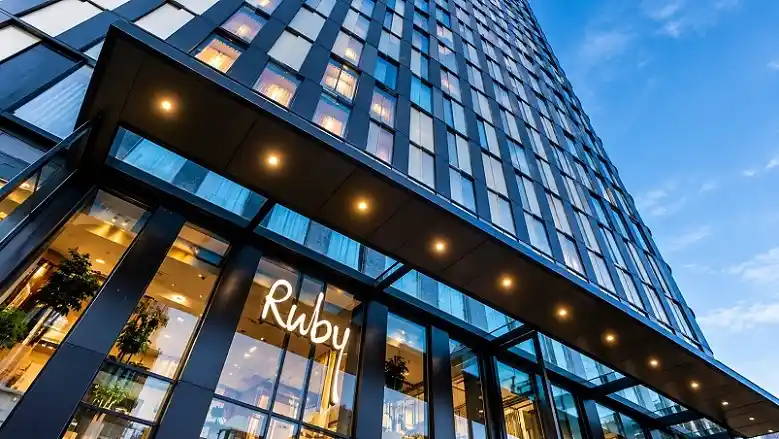
Image Credit: IHG
The planned transformation also raises interesting questions about the changing commercial priorities of Bangkok’s hotel owners and international operators. As this Bangkok Hotel News report examines, the decision comes amid continuing adjustments within the capital’s hospitality property market, where owners are reassessing asset performance, brand positioning, and opportunities to attract younger international visitors. The refurbished property, provisionally identified as Ruby Bangkok Sathorn, is scheduled to welcome guests during the third quarter of 2027.
A Billion-Baht Property Takes a Different Direction
The existing Holiday Inn Express Bangkok Sathorn occupies a strategic location within the Sathorn-Silom central business district, near the Empire Tower office complex. The 184-room property benefits from proximity to major commercial buildings, transportation connections, restaurants, entertainment venues, and established business communities.
AWC, led by Chief Executive Officer and President Wallapa Traisorat, is positioning the conversion as part of its broader strategy to enhance the value of existing hospitality assets while introducing differentiated accommodation experiences.
The development involves a property valued at approximately one billion baht, with renovation plans covering interior design, operational systems, and communal facilities.
However, the announcement has an additional commercial dimension. Only several months earlier, the same Holiday Inn Express property was reportedly being discreetly marketed for sale by AWC.
That earlier marketing effort raises the possibility that the conversion represents an alternative strategy following an unsuccessful disposal process. Nevertheless, there has been no publicly established confirmation that difficulties finding a buyer directly influenced the rebranding decision.
For IHG, retaining the property within its management portfolio under another brand could also provide commercial advantages. Such considerations remain speculative, however, rather than confirmed explanations from either company.
Bringing Ruby Hotels to Asia
Ruby Hotels represents a different hospitality proposition from the Holiday Inn Express format. Rather than concentrating primarily on efficient accommodation for business and leisure travelers, Ruby emphasizes what its developers describe as an engaging lifestyle experience.
The brand combines compact, thoughtfully designed accommodations with energetic communal environments intended to encourage interaction among guests and local residents.
Bangkok will become Ruby’s first destination in the Asia-Pacific region, with the proposed property described as the brand’s 42nd hotel worldwide.
AWC believes Bangkok’s international appeal, cultural diversity, entertainment scene, and expanding population of experience-oriented travelers make it particularly suitable for the concept.
The conversion also demonstrates how established hotel buildings can be repositioned to accommodate changing consumer preferences without requiring entirely new developments.
A Design Inspired by 1920s Siam
One of the project’s defining features will be its design concept, described as the “Charm of Siam 1920s.”
The interiors will reinterpret elements of Thailand’s historical elegance through contemporary furnishings, decorative details, and atmospheric spaces reflecting Bangkok’s cultural heritage.
The concept aims to combine the sophistication associated with historic Siam with the informal energy of a modern urban lifestyle hotel.
Importantly, the design will also incorporate references to Sathorn and Silom’s development into Bangkok’s commercial center.
Rather than presenting visitors with a standardized international hotel environment, the operators intend to create a property with a recognizable local identity.
The resulting guest experience is being promoted through the themes of style, soul, and storytelling.
Music and Social Spaces Become Central Attractions
Music will play an unusually prominent role throughout Ruby Bangkok Sathorn.
Guest rooms are expected to feature Marshall speakers, while guitars will be available for visitors wishing to play privately or participate in informal musical gatherings.
The hotel will also incorporate nightly live music performances and a carefully curated soundtrack throughout its public areas.
A major attraction will be its bar and communal facilities, designed to operate around the clock.
These spaces will function as informal meeting points where guests can work, socialize, enjoy refreshments, and participate in activities.
The approach reflects a broader hospitality trend in which hotel lobbies increasingly serve as destinations rather than simply reception areas.
AWC expects the communal facilities to attract both international visitors and Bangkok residents, creating opportunities for connections between travelers and the surrounding neighborhood.
IHG Strengthens Its Partnership With AWC
Rajit Sukumaran, IHG Hotels & Resorts’ Senior Vice President and Managing Director for East Asia and the Pacific, described the Ruby introduction as another important development in the companies’ longstanding relationship.
The partnership already encompasses InterContinental Chiang Mai The Mae Ping and several additional hospitality developments.
Projects associated with their broader collaboration include planned Kimpton properties in Hua Hin and Pattaya, alongside developments connected with Bangkok’s historic Chinatown district.
IHG regards Bangkok as an effective regional launching point for international hospitality brands, citing the city’s combination of global tourism demand and distinctive cultural character.
Ruby will reportedly become the sixth IHG brand introduced in Thailand ahead of expansion elsewhere in the region.
For AWC, the collaboration supports its wider ambition to develop tourism properties that generate employment, strengthen local supply chains, and encourage longer-term economic activity.
A New Chapter for Bangkok’s Hospitality Market
The conversion illustrates how hotel owners and operators are responding to increasingly diverse traveler expectations in Bangkok.
Traditional accommodation brands continue to serve important market segments, but lifestyle concepts are attracting attention through distinctive design, entertainment programming, and experiences extending beyond guestrooms.
Ruby Bangkok Sathorn will therefore face the challenge of establishing a recognizable identity within an already crowded market.
Its commercial performance will depend not only on international brand recognition but also on whether its music-centered facilities attract sufficient guest interest and sustained local participation.
For AWC and IHG, the project offers an opportunity to reposition an existing asset while maintaining their established business relationship. Whether the transformation ultimately delivers stronger financial performance remains to be seen, but its planned 2027 opening will provide another indication of how Bangkok’s hospitality sector is evolving toward experience-driven accommodation.
For more on the Ruby Brand by OHG, visit:
https://www.ihg.com/ruby-hotels/content/us/en/about-us
https://www.ihg.com/ruby-hotels/hotels/us/en/reservation