


For travelers checking into a Radisson hotel in Bangkok, London, Amsterdam, or other major international destinations, the familiar branding may suggest a traditional Western hospitality company. However, behind the recognizable Radisson name lies a significant transformation in global hotel ownership. The international Radisson Hotel Group, which operates across Europe, the Middle East, Africa, and Asia-Pacific, is controlled by Shanghai-based Jin Jiang International, one of China’s largest state-owned hospitality conglomerates.
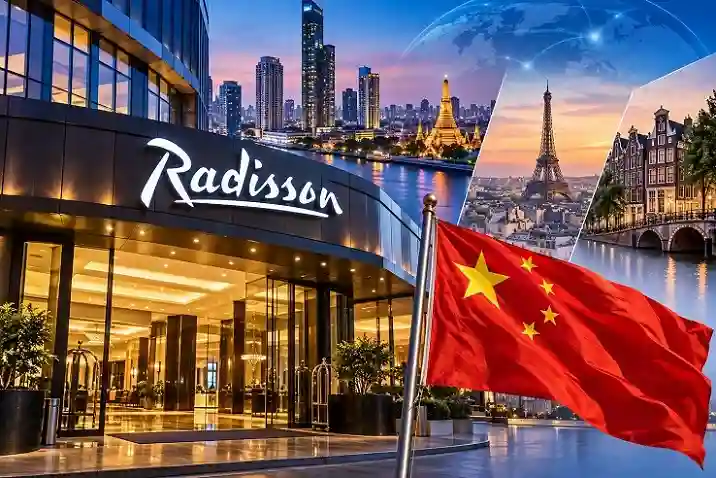
Image Credit: Bangkok Hotel News
The ownership arrangement remains relatively unfamiliar to many travelers, particularly those who associate Radisson with its American origins dating back to 1909. As this Bangkok Hotel News report examines, the transformation represents much more than a change in corporate shareholders. It illustrates how Chinese hospitality groups have expanded their international influence by acquiring established Western hotel brands while preserving their identities, customer relationships, and global distribution networks.
How Jin Jiang Acquired the Radisson Hotel Group
Jin Jiang International’s expansion into the Radisson business accelerated in 2018 when the Chinese conglomerate acquired a controlling interest in Radisson Hospitality through transactions involving the company’s previous majority shareholder, HNA Group.
The acquisition eventually resulted in Jin Jiang gaining full ownership of the international hospitality group, bringing an extensive collection of established hotel brands into its expanding portfolio.
For ordinary hotel guests, the transition was largely invisible. Properties continued operating under familiar Radisson names, reservation systems remained recognizable, and hotels maintained their established service standards.
Nevertheless, the acquisition represented a major shift in the ownership of an internationally recognized hospitality business.
Why Radisson Hotels in America Have Different Owners
A further restructuring occurred in 2022 when Choice Hotels International acquired Radisson Hotels Americas for approximately $675 million.
The transaction separated Radisson’s American operations from its international business, creating two distinct ownership structures operating across different geographical markets.
Choice Hotels acquired the Radisson business in the United States, Canada, Latin America, and the Caribbean, while Jin Jiang retained ownership of Radisson Hotel Group’s operations across Europe, the Middle East, Africa, and Asia-Pacific.
Consequently, travelers booking Radisson-branded accommodations in North America are dealing with a different corporate ownership structure from guests staying at Radisson properties in Thailand, Germany, or the United Kingdom.
This distinction is particularly important for understanding the international hotel industry’s increasingly complex ownership arrangements.
Bangkok Hotels Highlight the Chinese Group’s Growing Reach
Bangkok offers a particularly interesting illustration of Radisson’s international ownership structure.
Properties associated with the group include Radisson Blu Plaza Hotel Bangkok near Asok, Radisson Suites Bangkok Sukhumvit, and Radisson Hotel Chateau de Bangkok.
These hotels serve different market segments, ranging from upscale business accommodations to extended-stay hospitality, demonstrating the flexibility of the Radisson portfolio.
The group’s presence also highlights how international hotel operators can expand without purchasing every property carrying their brands.
Understanding the Asset-Light Hotel Business Model
Modern hospitality conglomerates frequently rely on management agreements and franchising arrangements rather than direct real estate ownership.
Under these arrangements, local investors may own hotel buildings while international operators supply branding, reservation technology, marketing support, and operational expertise.
Consequently, a Radisson-branded hotel in Bangkok is not necessarily owned as real estate by Jin Jiang International.
The distinction matters because brand ownership, hotel management, and property ownership can involve entirely different companies.
For Jin Jiang, this structure provides opportunities to expand its international commercial reach without financing every hotel development independently.
China’s Expanding Influence Across International Hospitality
Jin Jiang’s acquisition of Radisson forms part of China’s broader participation in international hospitality investment.
Radisson’s corporate information identifies more than 1,640 hotels and over 259,770 rooms operating or under development internationally, reflecting the considerable scale of the business.
Radisson Hotel Group
Established brands provide valuable advantages, including international recognition, established distribution systems, and relationships with hotel developers.
For Thailand, the arrangement also creates opportunities to attract travelers from multiple markets, including China’s substantial outbound tourism sector.
However, suggestions that Jin Jiang has confirmed widespread Thai expansion of its 7 Days Inn and Metropolo brands should be treated cautiously without specific development announcements.
What This Means for Travelers and Thailand’s Hotel Industry
The Radisson ownership story illustrates how dramatically international hospitality has changed without necessarily altering the experience guests encounter.
A familiar Western hotel name can now operate within a Chinese-controlled corporate group while individual properties remain locally owned and managed.
For Bangkok’s competitive hospitality industry, the implications extend beyond corporate ownership. International investment, management agreements, brand licensing, and tourism demand increasingly connect Thailand’s hotels with major global business groups.
Understanding these relationships provides a clearer picture of who controls internationally recognized hotel brands and how the industry’s financial structures are evolving.
For travelers, the Radisson name remains familiar, but the business behind it has undergone a fundamental transformation. As international hospitality ownership becomes increasingly interconnected, transparency about corporate control will remain important for investors, hotel operators, and guests alike.
For more on Jin Jiang Hotels, visit:
https://www.jjhotels.asia/index.html