


Key points
- Despite ongoing attempts by some industry data providers, consultants and officials to present a more optimistic outlook for Thailand’s tourism and hospitality sector by ‘manipulating figures’ and presenting rosy scenarios, the reality on the ground appears to be far less encouraging.
- In many cases, this Bangkok Hotel News report has learned that room rates are also being heavily discounted in an attempt to attract travelers, further reducing revenue yields and putting additional strain on operators already facing rising costs.
- For the latest on the hospitality industry in Bangkok, keep on logging to Bangkok Hotel News.
Bangkok Hotel News: Despite ongoing attempts by some industry data providers, consultants and officials to present a more optimistic outlook for Thailand’s tourism and hospitality sector by ‘manipulating figures’ and presenting rosy scenarios, the reality on the ground appears to be far less encouraging. Hotel operators, property owners and hospitality workers across Bangkok are increasingly reporting declining occupancy rates, weaker revenues and mounting financial pressures as international visitor arrivals remain below expectations and domestic spending continues to weaken.
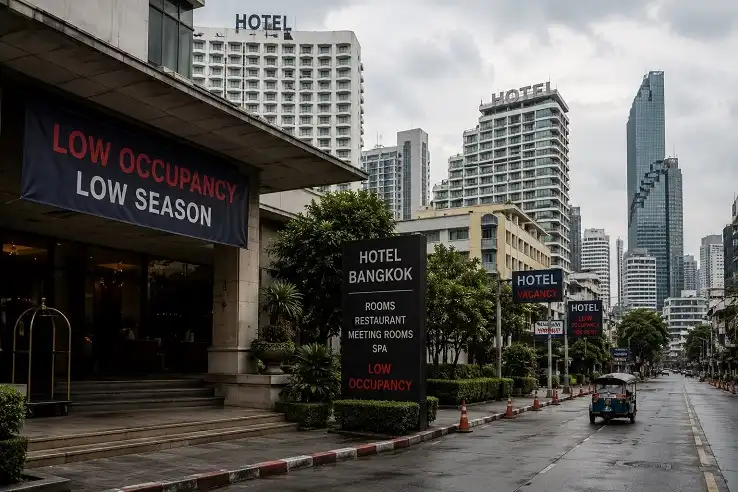
Image credit: Bangkok Hotel News
Bangkok, which now has more than 2,380 hotels and serviced apartment properties (not including properties featured on Airbnb) competing for guests, is experiencing one of its most challenging periods in recent years. Industry insiders estimate that many establishments are currently operating with occupancy levels ranging between 55 and 63 percent, significantly below the levels required to maximize profitability. In many cases, this Bangkok Hotel News report has learned that room rates are also being heavily discounted in an attempt to attract travelers, further reducing revenue yields and putting additional strain on operators already facing rising costs.
Oversupply Continues to Pressure the Market
The capital city has witnessed an aggressive expansion of hotel and serviced apartment developments over the last decade. While the growth was initially justified by strong tourism demand and expectations of continued visitor growth, the market is now grappling with a substantial oversupply of rooms.
Many hotel owners are finding it increasingly difficult to achieve sustainable returns on their investments. Properties ranging from budget accommodations to luxury establishments are competing intensely for a shrinking pool of visitors. As a result, price wars have become common, particularly in popular tourism districts and commercial areas.
Industry observers note that occupancy challenges are not limited to guest rooms alone. Restaurants, spas, meeting facilities, banquet halls and event venues within hotels are also experiencing weaker demand. Corporate meetings and conferences remain subdued, while discretionary consumer spending has slowed significantly amid economic uncertainty.
Global And Domestic Economic Headwinds
Several factors are contributing to the slowdown. The weakening global economy has reduced travel spending among many international visitors, while Thailand’s own domestic economy continues to face challenges. Rising household debt, cautious consumer sentiment and slowing business activity have all had a direct impact on tourism-related spending.
Hotel operators report that revenue streams that traditionally supplemented room income, including food and beverage operations, wellness services and event hosting, have also softened. This combination of lower occupancy and weaker ancillary revenue has created significant cash flow concerns for numerous establishments.
In response, some hotels have implemented cost-cutting measures, including reducing staff numbers, limiting operational hours in certain facilities and postponing renovation projects. Hospitality workers have increasingly expressed concerns regarding job security as management teams seek ways to contain expenses.
Regional Competition Intensifies
Adding to the pressure is growing competition from neighboring and regional destinations. Vietnam, Japan and Indonesia have emerged as particularly attractive alternatives for international travelers. Competitive pricing, attractive promotional campaigns, improving infrastructure and diverse tourism offerings have enabled these destinations to capture increasing market share.
Meanwhile, several destinations in South America are also attracting travelers seeking new experiences and value-oriented travel options. Many tourists now compare destinations based not only on price but also on overall value, accessibility and unique attractions.
The coming months will be closely watched by hotel owners, investors and industry stakeholders. While Bangkok remains one of Asia’s most iconic travel destinations with considerable long-term appeal, current market conditions highlight the growing challenges facing the hospitality sector. Without a meaningful rebound in tourist arrivals and stronger economic conditions, many hotels may continue to struggle with profitability, staffing levels and operational sustainability. The situation serves as a reminder that headline tourism figures alone do not always reflect the actual financial realities being experienced by hotels and serviced apartment operators throughout the city.
For the latest on the hospitality industry in Bangkok, keep on logging to Bangkok Hotel News.