


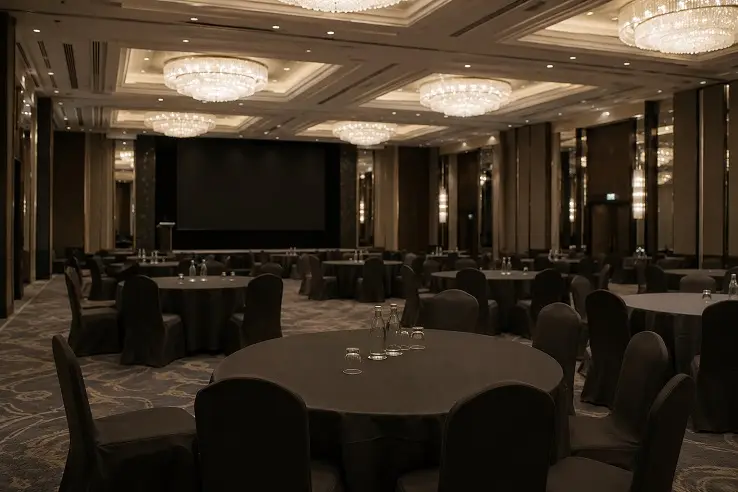
Image Credit: Bangkok Hotel News
For decades, Bangkok positioned itself as one of Asia’s leading destinations for meetings, incentives, conventions, and exhibitions. Major international hotel chains as well as local hospitality operators invested heavily in expansive ballroom facilities, state-of-the-art conference venues, and premium banquet services to cater to both domestic and foreign clients. However, this Bangkok Hotel News report finds that demand has slowed considerably over the past year, with many hotel operators quietly admitting that revenues from banquet sales and meeting room rentals have dropped to worrying levels. Some hotels are even reporting that event-related income has fallen below operational sustainability levels during certain months.
Middle East Crisis and Global Economic Weakness Impacting Travel and Events
Industry insiders say the ongoing instability in the Middle East is creating ripple effects throughout the global travel industry. Flight schedules have become increasingly unpredictable, while airfares on several international routes have risen sharply due to rerouting costs, reduced airline frequencies, and fuel-related pressures. As a result, many corporations and international organizations are either postponing events or shifting to virtual alternatives.
Bangkok’s hotel sector, which traditionally benefited from international conferences and regional business gatherings, is feeling the consequences directly. Event organizers are now more cautious with budgets, while multinational companies are cutting back on employee travel and large-scale corporate functions. Several MICE events that were tentatively planned for Bangkok have reportedly been canceled altogether or relocated to smaller regional destinations offering lower operational costs.
Hotel executives also say that clients are increasingly negotiating for steep discounts, complimentary add-ons, and shorter booking durations. In many cases, ballrooms that once hosted lavish multi-day events are now being rented only for brief seminars or scaled-down functions that generate far less income.
Weak Thai Economy Further Reducing Domestic Demand
Apart from international factors, Thailand’s own economic difficulties are significantly contributing to the downturn. Many local companies are cutting operational expenses and reducing discretionary spending, which includes hosting meetings, annual staff events, product launches, and celebrations at hotels.
Wedding bookings have also softened as families become more cautious about large expenditures. Some couples are opting for smaller ceremonies at restaurants or private residences instead of extravagant ballroom receptions at luxury hotels. Smaller businesses that once held quarterly meetings or training sessions at hotels are increasingly turning to co-working spaces or conducting online meetings instead.
Hospitality analysts note that the weakening purchasing power among Thai consumers is having a widespread effect across the tourism and hospitality sectors. Even individuals who previously hosted birthday celebrations, reunions, and private parties at hotels are now seeking more affordable alternatives.
Oversupply of Hotels Intensifying the Crisis
Bangkok’s highly saturated hospitality market is making the situation even more difficult. The capital currently has more than 2,060 hotels and serviced apartment properties, with approximately 76 percent offering meeting rooms, banquet halls, or ballroom facilities. This intense competition has created an oversupply of event spaces far beyond current demand levels.
Many hotels are now aggressively competing on price, leading to shrinking profit margins across the sector. Some properties are reportedly offering meeting packages at rates barely above operational cost simply to maintain occupancy and staff activity. Industry observers warn that such price wars are unsustainable and may eventually damage service quality standards.
Smaller independent hotels are particularly vulnerable because they lack the financial strength and international corporate networks available to major global chains. Several operators have already reduced staffing levels in banquet departments, while others are limiting maintenance expenditures on large event facilities to reduce operational costs.
Hotels Exploring Alternative Uses for Event Spaces
In response to declining bookings, some Bangkok hotels are attempting to reinvent how their meeting and ballroom spaces are utilized. A number of properties are converting sections into co-working areas, wellness activity zones, temporary exhibition spaces, or even hybrid studios for virtual events and livestream productions.
Others are focusing on niche markets such as intimate weddings, themed social gatherings, influencer events, and smaller luxury experiences designed to attract younger consumers. However, hotel managers acknowledge that these alternatives still generate far lower revenues compared to the large corporate functions and international conferences that once dominated the sector.
Despite ongoing challenges, industry experts believe the market could gradually recover if global geopolitical tensions ease and business confidence improves. However, recovery may take considerable time as both international and domestic clients continue exercising financial caution. The future of Bangkok’s hotel event industry will likely depend on how successfully operators can adapt to changing consumer behavior, economic realities, and increasing competition in an already overcrowded hospitality landscape.
For the latest on the hospitality industry in Bangkok and beyond, keep on logging to Bangkok Hotel News.