


Key points
- Bangkok hotels face a challenging high season as new room supply, changing source markets, geopolitical uncertainty and expensive aviation force operators to find new customers and entirely new sources of revenueImage Credit.
- In the middle of these rapidly changing conditions, this Bangkok Hotel News report looks at why hotels may need to abandon some long-established assumptions about high season and find much more imaginative ways of generating revenue.
- Chinese visitors remain immensely important to Thai tourism, but hotels would be making a mistake if their high-season strategy depended on a sudden return of Chinese mass-market demand.
Bangkok’s hotels are approaching what should traditionally be their most lucrative period of the year, but there is growing reason for operators to be nervous. The capital is certainly not short of tourists, and nobody should expect Bangkok’s hotels, shopping centers, restaurants and entertainment districts to suddenly become deserted. The more realistic threat is considerably less dramatic but potentially just as damaging: too many hotel rooms chasing demand that is no longer growing fast enough, while international uncertainty makes travelers more cautious about where they go and how much they spend.

Image Credit: Bangkok Hotel News
That combination could make the coming high season particularly unforgiving. Bangkok has continued adding hotel inventory at a time when Thailand’s tourism recovery has become less predictable, especially from some traditional source markets. Meanwhile, conflicts and economic pressures in Europe and the Middle East are filtering into fuel prices, airline operations, airfares and household spending. In the middle of these rapidly changing conditions, this Bangkok Hotel News report looks at why hotels may need to abandon some long-established assumptions about high season and find much more imaginative ways of generating revenue.
Bangkok’s Hotel Supply Is Becoming Difficult to Ignore
Drive around Bangkok today and the scale of hotel development is obvious.
Sukhumvit has become extraordinarily crowded with accommodation at almost every price level. New and repositioned properties have also appeared around Ploenchit, Ratchaprasong, Wireless Road, Langsuan, Silom, Sathorn, Surawong, Pratunam and Ratchaprarop, while Charoen Krung and the riverside continue attracting upscale and luxury developments.
The issue is not simply how many tourists visit Bangkok. It is how many rooms are competing for those visitors.
At the same time, the demand picture is hardly reassuring. Thailand recorded 6.6 million international arrivals during the second quarter of 2026, according to CBRE, representing an 8.1% year-on-year decline.
A Thai Hotels Association and Bank of Thailand survey released in September provided another warning. More than half of the hotel operators surveyed expected Thailand to receive fewer than 32 million international visitors this year, while fourth-quarter forward bookings were reportedly weaker than during the corresponding period of 2025, particularly from China.
This creates an uncomfortable equation.
Bangkok does not necessarily need to suffer a tourism collapse for individual hotels to experience financial pain. The city can remain visibly busy while occupancy and room rates are divided among an ever-larger number of properties.
China May Not Deliver the High-Season Rescue Many Expect
Chinese visitors remain immensely important to Thai tourism, but hotels would be making a mistake if their high-season strategy depended on a sudden return of Chinese mass-market demand.
The Chinese outbound market has changed, travelers have become more selective and Thailand now faces intense competition from Japan, South Korea, Vietnam and other destinations.
There are also important changes taking place within Chinese outbound travel itself. Independent travelers, younger consumers and more experienced visitors do not necessarily behave like the large tour groups Bangkok hotels once understood so well.
Hotels therefore need to diversify rather than wait for one source market to solve their occupancy problems.
India deserves greater attention, as do neighboring ASEAN countries and selected regional markets. But Bangkok hotels also need to look much closer to home—to Thai consumers and the city’s enormous expatriate population.
A hotel surrounded by millions of Bangkok residents should not depend almost entirely upon somebody purchasing an international airline ticket before that property can make money.
What Happens In Europe Will Eventually Reach Bangkok
The economic problems confronting Europe can appear remote from a Bangkok hotel lobby, but they are increasingly connected.
The prolonged Russia-Ukraine conflict continues to generate political, security and economic uncertainty across Europe. Energy costs, government spending pressures, inflation concerns and weaker consumer confidence can eventually influence discretionary expenditure. There is now even talks that Europe could go in a war mode very soon.
A holiday in Thailand is discretionary expenditure.
For a European couple considering a long-haul holiday, the decision is not determined simply by whether a Bangkok room costs THB4,500 or THB5,000. They are calculating the entire journey: airfares, insurance, restaurants, domestic transportation and the general cost of being away.
If household budgets are under pressure at home, expensive long-haul holidays become easier to postpone.
That makes Europe an important market to watch during the coming months, particularly if economic conditions deteriorate further.
The Middle East Presents an Even More Immediate Risk
Developments in the Middle East potentially affect Thailand through an even more direct channel. At the moment, the situation is fast escalating in the Middle-east with new fronts opened involving the Houthis and Saudi Arabia and while the war fronts involving Israel and Lebanon, and Iran and America are fast escalating.
The region sits across crucial aviation and energy routes linking Europe and Asia. Conflict, security concerns and disruption to oil and shipping routes can quickly affect airlines, fuel prices and flight schedules.
Energy prices have risen sharply during periods of escalation in 2026, with Brent crude moving toward $110 a barrel during September amid continuing uncertainty surrounding Middle Eastern energy infrastructure and shipping routes.
That matters enormously to tourism.
Jet fuel represents a major airline expense. When fuel costs rise substantially, airlines cannot simply absorb the increase forever. The consequences can eventually appear through higher fares, fuel surcharges, altered schedules, reduced frequencies or more expensive connecting journeys.
There is also the psychological impact.
European travelers contemplating a journey through Middle Eastern hubs may become more cautious when television screens are filled with missiles, airspace closures, security warnings and disrupted flight schedules.
For Bangkok hotels, the chain of consequences is straightforward:
Geopolitical conflict increases energy and aviation costs; higher aviation costs make Thailand more expensive to reach; expensive travel reduces discretionary demand; and weaker demand leaves more Bangkok hotels competing for fewer customers.
No Bangkok general manager can control what happens in Europe or the Middle East.
They can, however, change how dependent their hotel is upon conventional international room bookings.
Cutting Room Rates Could Be the Worst Possible Response
There will inevitably be pressure to discount if forward bookings disappoint.
That should be approached very carefully.
Once several competing hotels begin reducing prices, others frequently follow. Before long, an entire district can be discounting without generating meaningful additional demand.
Hotels should instead consider what can be added to a room package at relatively low cost while providing substantial perceived value.
Breakfast, late checkout, airport transportation, dining credits, laundry, spa credits and flexible arrival arrangements can make an offer more attractive without destroying the underlying room rate.
But Bangkok’s hotels need to go considerably further.
The fundamental question should no longer be simply, “How do we sell more rooms?”
It should be, “How many different ways can this property make money?”
Hotels Should Start Creating Their Own Events
Bangkok hotels have enormous amounts of meeting and function space that frequently sits unused.
Traditionally, sales departments wait for companies, associations or organizers to approach them.
Why wait?
Hotels should become event organizers themselves.
A Sathorn property could create a monthly financial-industry networking evening. A Sukhumvit hotel could develop an entrepreneurs’ club. Properties could organize singles dinners, technology forums, fashion pop-ups, investment discussions, expat gatherings, wine evenings, Sunday family events, wellness weekends or regional business networking sessions.
Instead of waiting for somebody to rent a ballroom, create an event people actually want to attend and charge them to attend it.
The hotel earns from tickets, food, beverages and potentially sponsorship while simultaneously introducing hundreds of people to the property.
Hotel Restaurants Need to Stop Looking Like Hotel Restaurants
The same rethink is necessary in food and beverage.
Bangkok residents have extraordinary restaurant choices. Nobody needs to eat in a hotel restaurant simply because it exists.
Hotels therefore need concepts capable of attracting customers who have absolutely no intention of booking a room.
That could mean month-long chef residencies, rotating provincial Thai cuisine, late-night supper clubs, visiting international chefs, limited-seat culinary experiences, Sunday family concepts, breakfast clubs, singles dinners or collaborations with successful independent restaurants.
Hotels should also consider transforming unused spaces into temporary F&B venues.
A suite can become a private dining room. A rooftop can host a seasonal restaurant. A lobby corner can accommodate rotating food or retail pop-ups.
The property itself becomes a platform.
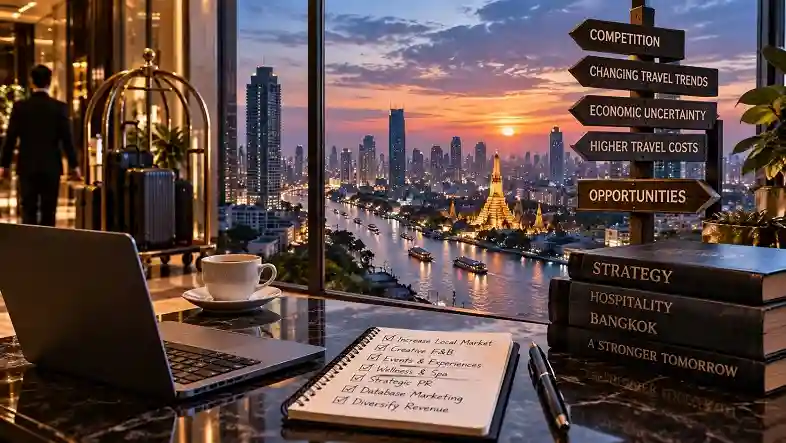
Image Credit: Bangkok Hotel News
Wellness Needs More Imagination Than Another Spa Promotion
Bangkok has considerable potential in wellness, but hotels need to create actual products rather than attaching the word “wellness” to conventional spa treatments.
Imagine a 48-Hour Bangkok Recovery Program specifically for exhausted long-haul travelers: carefully designed sleep environments, massage, healthy meals, hydration, digital downtime, late checkout and recovery treatments.
Another property could develop a serious sleep program with blackout rooms, improved sound insulation, premium mattresses, pillow selections, humidity control and sleep-oriented menus.
Hotels close to Bangkok’s major private hospitals can explore partnerships serving medical travelers and family members, particularly for appropriate post-treatment accommodation and longer recovery stays.
The objective is to give somebody a reason to choose that hotel beyond its room photograph and price.
Sell A Hotel Room More Than Once a Day
The conventional hotel day is another assumption worth challenging.
Why must a room always be sold from approximately 3 p.m. until noon the following day?
Bangkok receives transit passengers, travelers arriving early in the morning, passengers departing late at night, regional executives and people who simply need somewhere comfortable for several hours.
Hotels can develop six-hour, eight-hour and 12-hour products incorporating showers, sleep, meals and workspace.
An empty room at 10 a.m. produces zero revenue.
That same room could potentially generate day-use income and still be serviced before an evening guest arrives.
Similarly, empty bedrooms can become private offices during weaker periods. Add excellent internet, coffee, printing, video-conferencing facilities and lunch, and the customer no longer needs to be an overnight traveler.
Bangkok Residents and Expats Should Become a Source Market
One of the biggest opportunities is sitting immediately outside hotel doors.
Bangkok residents.
Hotels could develop annual local memberships covering selected use of swimming pools, fitness centers, coworking facilities, restaurants, spas and preferential staycation rates.
There could be separate memberships for families, wellness customers and business users.
Bangkok’s expatriate community also offers opportunities for business clubs, social gatherings, networking evenings, Sunday programs, dining memberships and wellness packages.
The underlying principle is important.
A person should not become commercially irrelevant to a hotel simply because they already have somewhere to sleep.
Turn Flight Disruption into A Product
Even aviation problems can create opportunities.
Hotels could develop a Bangkok Stopover Rescue Package for passengers affected by delays, cancellations or rerouting.
The product could include immediate booking, airport transportation, flexible check-in, shower and sleep facilities, meals, laundry, printing and assistance monitoring replacement flights.
Instead of waiting for stranded travelers to discover the hotel through an OTA, sales teams could establish relationships with airlines, ground handlers, travel insurers and airport-assistance companies.
That creates another demand channel largely separate from conventional leisure tourism.
Strategic PR Needs to Make a Serious Comeback
Bangkok hotels should also reconsider their increasing dependence on social media.
Social platforms have become extraordinarily crowded. Every hotel is publishing room photographs, cocktails, rooftop sunsets, buffets and influencer videos.
The problem is no longer producing content.
The problem is getting anybody to care.
Thousands of businesses are fighting for seconds of attention, and likes or video views should never automatically be interpreted as bookings.
This is where conventional strategic public relations needs a renaissance.
Hotels should create genuine stories and obtain meaningful editorial exposure in travel, business, lifestyle, food, wellness and specialist media.
A genuinely innovative sleep program can become a wellness story. A chef residency becomes a food story. An unusual business networking concept becomes a business story. A creative local membership program can become a hospitality story.
Good PR can also produce something increasingly valuable: searchable, credible third-party coverage that remains discoverable long after a social-media post has vanished down a feed.
Social media still has a role, but it should amplify genuine stories rather than substitute for them.
Database Marketing Could Become a Hotel’s Secret Weapon
The other neglected asset is the new prospect database. We are not talking about databases from the big chain membership or loyalty programs but rather locally sourced databases that are specially curated to contain names of individuals with the relevant spending capacity and their spending behavior patterns.
Hotels should develop smaller, curated and permission-based databases around actual customer interests and purchasing behavior.
Restaurant customers belong in one segment. Spa customers belong in another. Corporate decision-makers, event attendees, wedding planners, Bangkok residents, previous long-stay guests and regular international visitors all require different communication.
Someone who attended a financial networking evening should not subsequently receive ten irrelevant buffet promotions.
A customer who regularly attends Sunday brunch does not need constant advertisements for airport transfers.
Database marketing works when the message is relevant.
Done properly, a carefully curated database of genuinely engaged customers can become considerably more commercially useful than an enormous collection of passive social-media followers.
The objective should be to build direct relationships that neither an OTA nor a social-media algorithm controls.
Management Decisions Need to Become Much Faster
Hotels should also build a simple weekly commercial dashboard.
Track bookings by nationality, cancellations by market, booking lead times, average room rates, RevPAR, restaurant spending by non-guests, energy costs, direct versus OTA bookings and profitability by package.
Hotels should also monitor airfares from their most important source cities.
If bookings from Germany suddenly deteriorate while India strengthens, marketing expenditure should move accordingly.
If a Sunday local event produces better margins than another discounted room promotion, management needs to know immediately.
Waiting for monthly or quarterly meetings in a rapidly changing market is no longer adequate.
The Hotel Itself Has to Become the Destination
Perhaps the biggest strategic opportunity is to make Bangkok hotels difficult to compare.
A conventional hotel can easily become a commodity on an OTA screen: location, photograph, review score and price.
Hotels need reasons to exist beyond those four variables.
Bring Thai chefs, musicians, designers and craftspeople into temporary residencies. Create exhibitions, workshops, performances, private dinners and limited-edition products.
Turn different parts of the property into changing experiences.
Create reasons for somebody who stayed six months ago to return and discover something different.
Hotels should ultimately stop measuring themselves simply by rooms.
A modern Bangkok hotel can generate revenue through accommodation, restaurants, wellness, memberships, coworking, events, micro-stays, medical tourism, cultural experiences, meetings, local customers, corporate relationships and direct database marketing.
That is a considerably more resilient business than simply selling bedrooms.
A Difficult High Season Could Force a Necessary Reinvention
Bangkok remains one of the world’s great tourism cities, and there is no evidence that travelers are suddenly going to abandon it. The danger is subtler.
The city could remain busy while individual hotels experience considerable margin pressure because too many properties are chasing similar guests with similar rooms through the same distribution channels.
Europe’s economic and security uncertainty, continuing instability in the Middle East, volatile energy and aviation costs, uncertainty surrounding Chinese demand and Bangkok’s rapidly expanding hotel inventory make the traditional strategy of simply waiting for high season increasingly risky.
Hotels that respond only by discounting rooms and publishing more social-media promotions may discover that neither produces the business they expect.
The more resilient properties will be those prepared to create demand themselves: building events rather than waiting for event bookings, making restaurants destinations for Bangkok residents, developing genuinely distinctive wellness products, monetizing rooms throughout the day, cultivating Thai and expatriate customers, pursuing regional markets, using strategic PR to generate meaningful exposure and developing curated databases that allow them to communicate directly with customers without depending entirely upon OTAs or algorithms.
There is no single strategy capable of insulating Bangkok hotels from every geopolitical shock, weak source market, expensive airfare or new competitor. The answer is diversification. A property earning revenue from ten different customer groups and activities is inherently less exposed than one depending predominantly on foreign tourists purchasing conventional overnight rooms.
That may ultimately be the most important lesson of the coming high season. Bangkok hotels do not merely need more tourists. They need more reasons for people—tourists, residents, expatriates, companies, patients, business travelers and regional visitors—to walk through their doors and spend money. Properties that make that transition could emerge from a difficult period with stronger brands, better direct customer relationships and much more resilient businesses. Those that continue relying on yesterday’s hotel model may discover that Bangkok can be full of visitors while their own rooms, restaurants and meeting spaces remain frustratingly underused.
Hotels in Bangkok needing help with new innovative and creative solutions and AI strategies along with conventional PR packages and databases marketing programs can contact us as we are now offering special packages that start as low as only baht 5,000 and Bt 8,000 barter for a month’s programs and exposures! We literally act as you remote inhouse Marcom team but remotely. For more details, drop an email at mktwiz789@gmail.com
Read Also: