


Key points
- Bangkok’s luxury hotel restaurants, rooftop bars, Sunday brunches, and fine-dining venues are confronting a noticeable slowdown in local and expatriate customers, raising fresh concerns about a segment that has become increasingly important to hotel profitability.
- There is often surprisingly little experimentation with neighborhood partnerships, corporate communities, customer databases, local membership concepts, chef collaborations, cultural events, cross-promotions with outside businesses, or unconventional campaigns capable of turning a restaurant into a destination in its own right.
- a chef, a menu, a view, a buffet, a seasonal promotion, or a discount.
Bangkok’s luxury hotel restaurants, rooftop bars, Sunday brunches, and fine-dining venues are confronting a noticeable slowdown in local and expatriate customers, raising fresh concerns about a segment that has become increasingly important to hotel profitability. There are currently more than 4,486 hotel restaurants as of 1st September 2026 across Bangkok not including bars and bakery outlets. Almost 62% of them are running at losses!
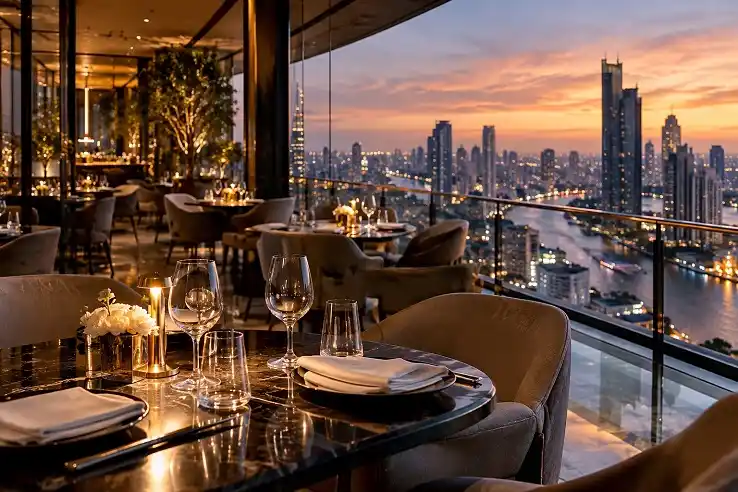
Image Credit: Bangkok Hotel News
For years, affluent Bangkok residents and well-paid expatriates helped fill tables regardless of fluctuations in international visitor numbers. During the past quarter, however, that dependable customer base appears to have become considerably more selective.
The change comes as Thailand’s broader restaurant sector faces weaker consumer spending, higher operating costs, and increasingly intense competition. Premium hotel restaurants are particularly exposed because of their higher staffing, ingredient, rental-equivalent, and operational costs. In assessing the changing landscape, this Bangkok Hotel News report finds that the problem extends beyond economic conditions: hotels themselves may also need to reconsider how they market their restaurants and communicate with Bangkok residents.
Premium Dining Feels the Pressure
Fine-dining and full-service restaurants appear to be among the hardest hit. Industry reports during 2026 have pointed to substantial weakness in restaurant spending, with some high-end operators reporting sales declines approaching 35 to 40% compared with stronger periods.
For hotel restaurants, even a considerably smaller reduction in covers can hurt profitability. Their business models frequently depend on premium menus, wine and cocktail sales, private dining, and high-margin special events. Empty tables therefore represent more than lost food revenue.
Bangkok residents also have extraordinary choice. Independent omakase restaurants, chef-driven bistros, neighborhood wine bars, modern Thai restaurants, and small specialty concepts are competing aggressively for exactly the same affluent customers that five-star hotels want.
Local Thais Are Becoming More Selective
Economic uncertainty has changed spending behavior even among higher-income Bangkok residents. A dinner costing several thousand baht per person is increasingly being weighed against independent restaurants offering sophisticated food, fashionable surroundings, and a perception of better value.
Expatriates are facing similar pressures. Higher living expenses and changing corporate compensation packages have made frequent luxury hotel dining harder to justify. An expensive weekend brunch or rooftop evening that was previously almost routine can become an occasional indulgence.
This does not mean Bangkok residents have stopped spending. Rather, they are becoming more demanding about where they spend, creating a serious challenge for hotel outlets that previously benefited from reputation and location alone.
Hotels Must Shoulder Some of the Blame
Hotels cannot attribute the entire downturn to economic conditions. In some cases, their own increasingly predictable approach to marketing may be contributing to the problem.
Many properties continue to depend heavily on Facebook, Instagram, YouTube, influencers, and their hotel group’s loyalty program to promote restaurants.
These remain valuable channels, but constantly communicating through the same platforms can result in hotels repeatedly reaching existing followers rather than developing genuinely new audiences.
There is often surprisingly little experimentation with neighborhood partnerships, corporate communities, customer databases, local membership concepts, chef collaborations, cultural events, cross-promotions with outside businesses, or unconventional campaigns capable of turning a restaurant into a destination in its own right.
Independent Bangkok restaurants frequently create a distinctive personality and community around themselves. Some hotel restaurants, by comparison, continue promoting essentially the same formula: a chef, a menu, a view, a buffet, a seasonal promotion, or a discount.
Public relations is another weakness. Some hotels have reduced dedicated PR resources, while others have no specialist restaurant PR personnel at all.
Communications may instead fall to overstretched marketing teams simultaneously responsible for rooms, weddings, meetings, social media, digital campaigns, and corporate brand requirements.
The result is that hotels can spend heavily creating restaurants, recruiting chefs, and developing elaborate menus, yet invest comparatively little in continuously getting the story in front of potential customers. In a crowded dining market, having a good restaurant is no longer enough if too few people are hearing anything interesting about it.
Discounts Alone Will Not Fix the Problem
Hotels are responding with resident promotions, credit-card offers, lower-priced lunches, loyalty benefits, and other incentives. Some are also attempting to make their restaurants feel less like facilities primarily serving hotel guests and more like neighborhood venues.
Price promotions may produce short-term traffic, but excessive discounting carries risks. Customers can become accustomed to waiting for the next offer, while repeated discounts potentially weaken the premium positioning that luxury hotels have spent years establishing.
A more durable response would combine competitive pricing with stronger storytelling, targeted databases, local partnerships, creative events, professional PR, and marketing designed to reach beyond existing social-media followers.
Bangkok Hotels Need to Rediscover Their Local Audience
The year-end tourism season may bring stronger international traffic, but hotels should not assume foreign visitors will simply replace disappearing local diners. Bangkok residents and expatriates provide valuable year-round business and can support restaurants when room occupancy weakens.
The current downturn should therefore serve as a warning. Economic pressure is certainly hurting premium dining, but hotels must examine their own contribution to the problem. Properties that continue relying on familiar social-media posts, loyalty programs, discounts, and limited PR risk becoming invisible in one of Asia’s most competitive restaurant cities. Those willing to experiment, communicate creatively, cultivate local communities, and give diners genuinely new reasons to return will be better positioned to rebuild traffic.
Those interested in purchasing a detailed report on the Bangkok Hotel Restaurant market and performance in the last three months can contact us at : drnikhil@thailandmedical.news and we also have a updated databases of all the hotel restaurants in Bangkok, names of food and beverage directors, chefs, restaurant managers, purchasing managers, restaurant concepts, menus, area competitive analysis etc with key contact details for sale