


Key points
- In the midst of the escalating conflict in the Middle East that has disrupted international flights and left many travelers unable to return home, Thailand’s tourism authorities, government ministries and hotels have mobilized an unprecedented support operation for affected visitors.
- The latest measures are aimed at easing the financial and logistical strain on thousands of international tourists who found themselves stuck in the Kingdom due to cancelled flights and airspace closures, boosting Thailand’s reputation as a hospitable destination even in times of global crisis.
- As the crisis reverberates across global flight networks, the Tourism Authority of Thailand (TAT), working closely with the Ministry of Tourism and Sports and hotel and travel industry partners, has rolled out a comprehensive relief package that includes daily compensation of up to 2,000 baht for each stranded tourist.
Hotel News: In the midst of the escalating conflict in the Middle East that has disrupted international flights and left many travelers unable to return home, Thailand’s tourism authorities, government ministries and hotels have mobilized an unprecedented support operation for affected visitors. The latest measures are aimed at easing the financial and logistical strain on thousands of international tourists who found themselves stuck in the Kingdom due to cancelled flights and airspace closures, boosting Thailand’s reputation as a hospitable destination even in times of global crisis.

Image Credit: Bangkok Hotel News
As the crisis reverberates across global flight networks, the Tourism Authority of Thailand (TAT), working closely with the Ministry of Tourism and Sports and hotel and travel industry partners, has rolled out a comprehensive relief package that includes daily compensation of up to 2,000 baht for each stranded tourist. This Hotel News report reflects the latest policy implementation, which also includes targeted support in popular destinations such as Phuket, Chiang Mai, Krabi and Bangkok to help cushion the financial burden of extended stays beyond visitors’ original itineraries.
Thailand Hotels Respond
Many hotels have responded positively, offering heavily discounted room rates along with free meals to certain stranded travelers. Hotels from Bangkok to Chiangmai, Mae Hong Song, Pai, Phuket etc have all come up with special discounted rates for all tourists that have been affected by the Middle-East war.
Coordinated Response and Daily Assistance
In response to the sudden surge of visitors facing unplanned accommodation costs and logistical uncertainty, officials have invoked provisions of the Foreign Tourist Relief Fund, enabling compensation for losses linked to prolonged stays caused by force majeure events like war. Under these regulations, eligible travelers can receive up to 2,000 baht per day, for a period that reflects genuine hardship, to cover additional meals, lodging and transport while flights are rescheduled or rerouted.
But financial support is just one element of a larger, coordinated response. The Ministry of Tourism and Sports has been actively liaising with the Tourism Industry Council of Thailand, provincial tourism offices and hotel associations to negotiate special discount rates on rooms and travel services. Many hotels in major tourism hubs are offering reduced rates or waived rescheduling and cancellation fees to ease pressure on budgets already strained by extended travel commitments.
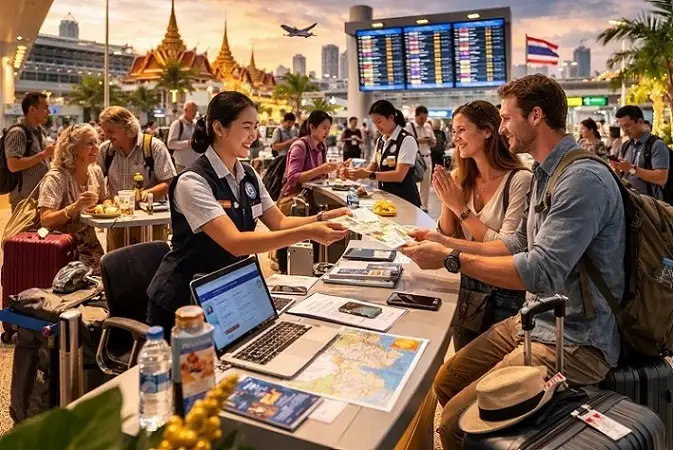
Image Credit: Bangkok Hotel News
On-the-Ground Support and Monitoring
Beyond compensation and cost reduction, TAT has established a Tourism Crisis Monitoring Centre to track the evolving situation in the region and provide real-time support. From this hub, authorities coordinate with airport officials, airline partners, and tourist police to ensure that stranded tourists have access to essential services and up-to-date information. At Bangkok’s major airports, passengers have been offered temporary rest areas, refreshments and logistical help while they await updates on alternative flights.
Provincial tourism and sports offices have been deployed to assess conditions directly at hotels with high numbers of impacted visitors, offering multilingual assistance where needed and helping with visa extensions, travel advisories and health and safety guidance. Additionally, emergency hotlines are operational around the clock to provide quick responses to traveler’s questions or emerging needs.
Turning Crisis into Confidence
For many tourists, these support measures are more than financial relief — they represent Thailand’s commitment to visitor welfare during uncertain times. By partnering with private sector stakeholders and utilizing existing tourism infrastructure, Thai authorities are not only assisting those stranded but also strengthening Thailand’s image as a resilient, caring destination that looks after all travelers. The policies could set a new benchmark for crisis management in travel and tourism, reinforcing international confidence in the Kingdom’s hospitality sector.
For the latest on how the Middle-East war is disrupting the global travel and hospitality industry, keep on logging to Bangkok Hotel News.