


Key points
- Across the global hotel industry, AI-driven discovery tools, conversational assistants, and embedded booking agents are beginning to alter how travelers search, compare, and ultimately choose where to stay.
- In that gap, opportunity is forming, and this Bangkok Hotel Technology News report captures why the balance of power may be starting to tilt.
- Building a competitive AI interface requires distribution on a scale Booking.
Bangkok Hotel Technology News: A Quiet Shift Becoming Impossible to Ignore
For years, artificial intelligence hovered on the fringes of online travel, promising efficiency but rarely challenging the dominance of major online travel agencies. That phase is over. Across the global hotel industry, AI-driven discovery tools, conversational assistants, and embedded booking agents are beginning to alter how travelers search, compare, and ultimately choose where to stay. What once felt experimental now looks structural, especially as consumer habits shift toward conversational interfaces that remove friction from the planning process.
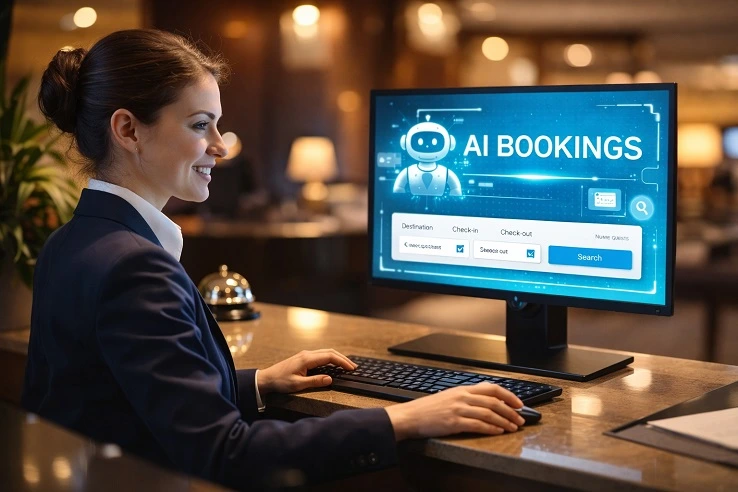
Image Credit: Bangkok Hotel News
The core tension is simple. Traditional OTAs remain powerful because of inventory depth, payment handling, and consumer trust, yet their discovery experience has barely evolved. Endless ranked lists and rigid filters still overwhelm rather than guide. AI platforms, by contrast, refine intent through natural language, learning preferences iteratively and narrowing options with speed and clarity. In that gap, opportunity is forming, and this Bangkok Hotel Technology News report captures why the balance of power may be starting to tilt.
Why Discovery Is the New Battleground
Hotel discovery has long been inefficient. Users scroll, compare tabs, and second-guess prices, often unsure whether they are seeing the “best” option or simply the most promoted one. Conversational search changes that dynamic by acting as a decision partner rather than a directory. Travelers can ask nuanced questions, adjust priorities mid-conversation, and reduce cognitive overload. This advantage matters because travel remains a high-cost, low-frequency purchase, where reassurance and confidence are as important as price.
OTAs still hold an edge here. They manage cancellations, refunds, and customer support at scale, reducing perceived risk. Yet AI platforms are closing that gap quickly. With integrated payments, checkout capabilities, and agent-like booking flows, AI is evolving into an end-to-end travel intermediary. The user interface, not the inventory, is becoming the primary source of differentiation.
Booking.com and the Value of Visibility
Booking.com built its enormous valuation by controlling what travelers see and monetising that visibility. Commissions, preferred placements, loyalty programs, and sponsored listings all feed a model where every pixel carries value. Beneath the surface sits an increasingly important merchant model, where Booking.com collects payments upfront, earns interest on float, captures foreign exchange spreads, and routes funds back to hotels through virtual credit cards that add further cost to properties.
This system works exceptionally well when travelers begin their journey on Booking.com’s interface or arrive there via paid search. In 2024 alone, marketing spend exceeded seven billion dollars, optimized for a world where travelers actively seek booking sites. AI-assisted discovery disrupts that flow. When travelers ask an assistant for recommendations, the decision logic happens upstream, and Booking.com’s interface may never appear.
Fragmentation, Not One Big Threat
The industry once feared a single dominant AI platform would emerge and control travel discovery. Instead, the risk has multiplied. OpenAI, Google, Microsoft, Amazon, Apple, and others are all embedding travel capabilities into their ecosystems. Each platform controls its own interface, recommendation logic, and visibility hierarchy. For Booking.com, that means shifting from selling placement to potentially buying it, while competing across a dozen new front doors it does not own.

Image Credit: Bangkok Hotel News
Partnerships have been positioned as strategic wins, but they reveal an uncomfortable truth. In most cases, Booking.com supplies inventory and infrastructure while AI platforms own the user relationship. Hotels are not locked into this arrangement. Brands can connect directly through their reservation systems, while independents can reach AI assistants via channel managers or GDS providers. Emerging open standards further reduce reliance on a single aggregator.
What This Means for Valuations and Power
Markets still price Booking Holdings as if discovery control and pricing power will persist. That assumption is increasingly fragile. Building a competitive AI interface requires distribution on a scale Booking.com lacks, while maintaining pricing power as a backend supplier requires leverage that weakens as inventory sources multiply. Visibility economics are fragmenting, and with them, the margins investors have come to expect.
This does not signal the collapse of OTAs. Mature, cash-generating businesses rarely disappear overnight. Instead, the risk is repricing. As discovery moves upstream into AI interfaces, OTAs are pushed down the funnel, where take rates compress and leverage shifts to whoever controls intent creation.
Trust, Adoption, and the Pace of Change
Consumer trust remains the final barrier. Delegating a major vacation to an AI assistant feels risky, until it doesn’t. Adoption is likely to begin with small, repeat bookings and accelerate rapidly once confidence forms. The greater long-term risk is not failure but sameness, where AI systems recommend identical hotels and experiences to everyone. Personalization will determine whether AI enriches travel or flattens it.
Independent hotels may be the surprise beneficiaries. AI weakens the discovery chokehold that justified high commissions and allows properties to present richer, differentiated offers directly. With modern tools reducing technical barriers, even modest shifts toward direct bookings could materially improve hotel economics.
The future of online travel will not be decided by whether AI “kills” OTAs, but by who controls discovery, who earns trust, and who captures value when the interface changes. Booking.com may still hold the cake, but for the first time in years, multiple AI-powered guests are lining up to take a slice.
For the latest Bangkok Hotel Technology News, keep on logging to Bangkok Hotel News.