


A major shareholder rebellion is gathering momentum at French hospitality giant Accor, with activist investment fund Parvus Asset Management demanding the departure of longtime chairman and CEO Sébastien Bazin. The confrontation, triggered by a controversial €1.6 billion acquisition involving lifestyle hospitality group Ennismore, threatens to disrupt Accor’s leadership succession and potentially reshape the future of one of the world’s largest hotel companies.
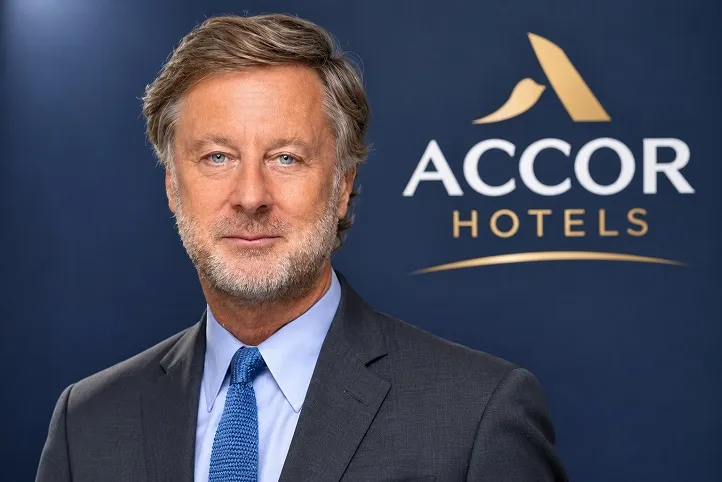
Image Credit: Bangkok Hotel News
The dispute could become considerably more serious if other influential investors decide to challenge Bazin’s leadership. Emerging speculation suggests that major shareholders, including Kingdom Holding Company, Qatar Investment Authority and BlackRock, could potentially become involved in the growing confrontation, although none has publicly confirmed support for his removal. As this Bangkok Hotel News report examines, the battle extends beyond one executive’s position, raising fundamental questions about corporate governance, shareholder returns and the direction of Accor’s international hospitality empire.
Accor’s Largest Shareholder Demands Leadership Changes
London-based Parvus Asset Management, which holds approximately 14.1 percent of Accor’s share capital according to its November 19 statement, has openly challenged Bazin’s leadership after years of private discussions with the company.
The activist investor accuses Accor of pursuing an unfocused strategy, making inconsistent capital allocation decisions and failing to deliver shareholder returns comparable with those of major international hotel competitors.
Parvus claims that Accor generated total shareholder returns of approximately 99 percent between December 2013 and November 2026, compared with 593 percent for InterContinental Hotels Group, 863 percent for Hilton and 950 percent for Marriott International.
These figures, which include reinvested dividends, form the foundation of the fund’s argument that Accor has significantly underperformed despite expanding its global hospitality portfolio.
Parvus has warned that unless meaningful changes occur, it intends to challenge the composition of Accor’s board and management at the next annual shareholders’ meeting.
The confrontation represents one of the most significant public challenges to Bazin since he assumed leadership in 2013.
Could Other Powerful Shareholders Join the Revolt?
The possibility of additional institutional shareholders joining Parvus has introduced uncertainty surrounding Accor’s leadership.
Kingdom Holding Company, Qatar Investment Authority and BlackRock are among the influential investors whose positions could become important in determining the outcome.
However, speculation about their possible participation must be distinguished from confirmed shareholder action. There is currently no established public declaration that these investors have joined Parvus in demanding Bazin’s removal.
Their involvement would nevertheless substantially alter the balance of power.
Although Parvus is Accor’s largest individual shareholder, its holding does not provide sufficient voting control to independently force changes.
French corporate governance rules also permit qualifying long-term shareholders to benefit from double voting rights, meaning ownership percentages do not necessarily translate directly into equivalent voting power.
Consequently, any successful campaign against Bazin would likely require cooperation from other institutional investors.
The €1.6 Billion Ennismore Deal Sparks Outrage
At the center of the dispute is Accor’s November 17 announcement that it would acquire the remaining 44.3 percent minority interest in Ennismore for approximately €1.6 billion.
The transaction values Ennismore’s equity at roughly €3.7 billion, representing approximately 18 times its anticipated 2027 EBITDA.
Accor intends to complete the acquisition through three installments, purchasing 25.4 percent by January 2027, another 6.3 percent by July 2027 and the remaining 12.6 percent by January 2028.
Parvus questions why an executive team approaching an announced leadership transition should commit such substantial capital.
The fund has also highlighted Accor’s earlier decision to sell a 10.8 percent Ennismore stake for approximately €185 million in 2022.
According to Parvus, repurchasing that same interest would now cost approximately €360 million, nearly twice the original proceeds.
The apparent reversal has intensified criticism of management’s financial decision-making.
Bazin Defends His Controversial Strategy
Bazin maintains that Ennismore represents one of Accor’s most valuable growth opportunities.
Established by entrepreneur Sharan Pasricha in 2011, Ennismore has developed into an international lifestyle hospitality platform operating approximately 200 hotels and more than 800 restaurants and bars across 40 countries.
Its portfolio includes The Hoxton, Mama Shelter, SLS, Mondrian, Rixos and Faena, alongside hospitality and dining businesses such as Paris Society.
Although Ennismore represents only approximately 5 percent of Accor’s hotel rooms, it contributes nearly 20 percent of recurring EBITDA.
Management also attributes approximately 40 percent of Accor’s EBITDA growth over the previous three years to the business.
Bazin argues that increasing ownership will allow Accor to capture more of Ennismore’s earnings while gaining greater flexibility over future strategic decisions.
Importantly, the acquisition does not necessarily eliminate the possibility of an eventual stock market listing or the introduction of new investment partners.
Bazin has also explained that contractual liquidity arrangements with Ennismore’s minority shareholders were established several years ago, challenging suggestions that the acquisition emerged unexpectedly.
Financial Analysts Question Accor’s Spending Priorities
The transaction has nevertheless attracted skepticism from investment analysts.
Morgan Stanley downgraded Accor from overweight to equal-weight, warning that the Ennismore acquisition could increase leverage by approximately 0.5 times while reducing flexibility for additional shareholder distributions.
Accor plans to finance the acquisition partly through accelerated disposals of nonstrategic assets, additional credit facilities and potentially the issuance of company shares.
Management insists that the transaction will not jeopardize its planned €500 million share repurchase program or investment-grade credit rating. Other analysts have taken a more favorable position.
Independent research firm AlphaValue believes the Ennismore investment could generate substantial long-term value, particularly if the business eventually pursues a successful public listing.
The disagreement reflects competing investment philosophies: returning available capital to shareholders versus reinvesting in businesses offering stronger future growth.
Governance Controversies Add to Bazin’s Problems
The shareholder confrontation follows an uncomfortable period for Accor’s corporate governance.
Earlier in 2026, allegations raised by short seller Grizzly Research prompted an investigation into certain company relationships and executive appointments.
The investigation, conducted by Paris law firm BDGS, examined matters including Accor’s dealings with Paris Society.
Accor’s board subsequently announced that the investigation found no breach of legal or fiduciary obligations.
Nevertheless, the episode contributed to heightened scrutiny of management oversight.
Shareholder opposition to executive remuneration at the May annual meeting also demonstrated dissatisfaction with certain governance arrangements.
Critics additionally question whether Accor’s expansion from approximately 13 brands to 45 under Bazin has produced unnecessary organizational complexity.
Supporters, however, argue that the transformation has successfully repositioned Accor as a diversified, asset-light international hospitality group.
A Leadership Succession Suddenly Under Pressure
Bazin has already announced plans to leave his position by May 2028, with an external advisory firm assisting Accor’s board in identifying his successor.
Parvus believes that waiting until then could allow the outgoing leadership to make financial commitments that constrain future management.
The activist investor has therefore raised the possibility of seeking changes to the board if its concerns remain unresolved.
However, Parvus cannot independently dismiss Accor’s CEO.
Under French corporate governance arrangements, the board possesses the authority to remove the chief executive, while shareholders can influence its composition through voting.
An accelerated succession, rather than an immediate dismissal, could consequently emerge as a potential compromise.
The timing is particularly sensitive because the first Ennismore acquisition payment is scheduled before Accor’s next ordinary annual shareholders’ meeting.
Parvus Has Successfully Challenged Corporate Management Before
Parvus has previously demonstrated its willingness to confront major corporations over strategic decisions.
In 2016, the fund opposed British gambling operator William Hill’s proposed merger with Canadian company Amaya, arguing that the transaction lacked strategic justification.
Other shareholders subsequently supported the opposition, and the proposed merger was abandoned.
The precedent illustrates how a substantial minority investor can influence corporate decisions without possessing majority ownership.
Whether Parvus can achieve comparable influence at Accor remains uncertain.
The French hotel group operates more than 5,800 properties across over 110 countries, making any leadership disruption potentially significant for international hotel owners, franchise partners and investors.
Accor Faces a Defining Battle Over Its Future
The confrontation ultimately concerns more than whether Sébastien Bazin leaves before his scheduled retirement. It raises fundamental questions about how Accor should balance acquisitions, financial discipline, shareholder returns and long-term hospitality expansion. With Parvus demanding change and other major investors potentially holding decisive influence, Accor’s board faces increasing pressure to demonstrate that its decisions serve shareholders beyond the current leadership’s tenure. The outcome could shape the company’s strategic direction for years to come.
For more on Accor Hotels, visit:
https://group.accor.com/en/hotel-development