


Bangkok Hotel News: Bangkok’s hotel landscape has entered a new era of scale and complexity, with the Thai capital now hosting an extraordinary concentration of branded hotels and serviced apartments that is reshaping how visitors experience the city. As of the end of January 2026, Bangkok officially records 1,318 licensed hotels and service apartments offering a combined 156,402 room keys, making it one of Asia’s most saturated urban hospitality markets. (While many hotel consulting companies and bank reports on the hotel industry might give varying figures, this latest update took 2 months and more than 85 part-time staff to not only compile these data but also help us develop a updated database of room rates, restaurant and bar types in these premises and menu prices, amenities, spa packages, meeting room rates and a database of over 15,000 key hospitality personnel in Bangkok.)
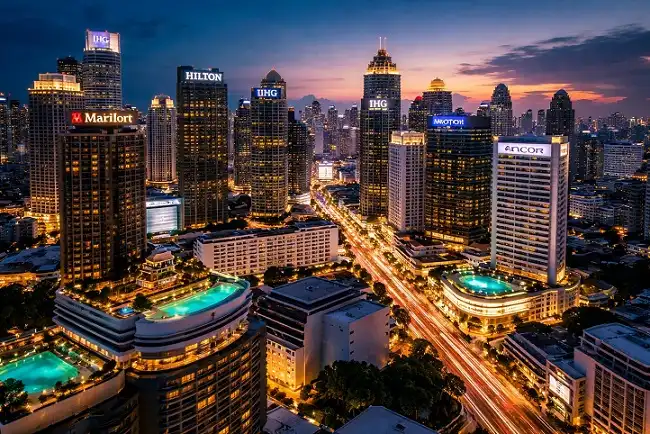
Image Credit: Bangkok Hotel News
Approximately 17 new hotel properties, totaling about 3,942 rooms (keys), are scheduled to open in Bangkok in 2026. The pipeline is heavily concentrated in the luxury, upper-upscale, and upscale segments, adding significant competitive pressure to the city’s hospitality market.
What was once a straightforward choice between a few international names has evolved into a dense ecosystem dominated by global chains and regional hospitality giants, leaving many travelers — and even local residents — struggling to distinguish between brands, concepts, and property tiers. The worse are similarity in hotel names and the newer method of longer hotel names as besides the brand name and city, hotel names need to these days also incorporate the districts they are in and sometimes even the Soi number to avoid guest ending up in the wrong properties!
As an example…there are at least 4-5 Hyatt-branded properties directly in or immediately adjacent to the Sukhumvit area of Bangkok. Key properties include the Hyatt Regency Bangkok Sukhumvit, Hyatt Place Bangkok Sukhumvit 1, Hyatt Place Bangkok Sukhumvit 24, Park Hyatt Bangkok (nearby Phloen Chit), and the Grand Hyatt Erawan Bangkok (near Ratchaprasong/Sukhumvit border). There are at least another 4 Hyatt properties coming in this same vicinity soon including two new properties and two that involved rebrandings.
There are at least 11 Holiday Inn and Holiday Inn Express properties in Bangkok, with a significant concentration in the Sukhumvit area. Key locations include Holiday Inn Express Bangkok Sukhumvit 11, Holiday Inn Bangkok Sukhumvit 22, and Holiday Inn Express Bangkok Asoke, Holiday Inn Sukhumvit Soi 20 and the rest of Bangkok include Holiday Inn Express Bangkok Soi Soonvijai, Holiday Inn Bangkok (Ploenchit), Holiday Inn Express Bangkok Siam, Holiday Inn Express Bangkok Sathorn, Holiday Inn Express & Suites Bangkok Central Pier, Holiday Inn Bangkok Silom and Holiday Inn Express Bangkok Phayathai. Another 5 Holiday Inns are due to be opened in Bangkok as well within this next 18 months including the Holiday Inn Express Thonglor and the Holiday Inn Don Muang airport in the next few months.
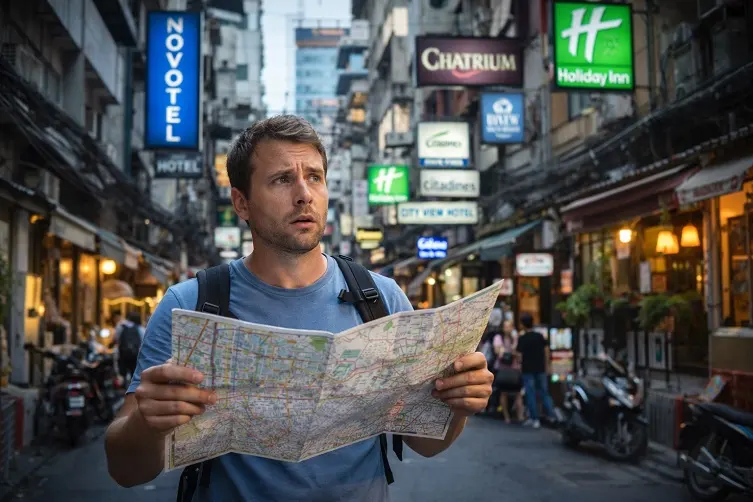
Image Credit: Bangkok Hotel News.
The growth has been driven by aggressive expansion strategies from multinational operators, rising tourism demand, and the city’s enduring appeal as a regional hub. In recent years, this Bangkok Hotel News report highlights how major players have rapidly multiplied their presence across multiple districts, often launching several brands under the same corporate umbrella within walking distance of one another. For travelers scrolling through booking platforms, the sheer number of similar-sounding properties has become a recurring source of confusion, especially when hotels under different brand tiers appear side by side with only subtle differences in style or pricing.
A City Dominated by Major Hotel Groups
The market is increasingly controlled by powerful hospitality groups including IHG Hotels, Marriott Hotels, Accor, Hilton, Hyatt, Minor Hotels, Onyx Hospitality, Centara Hotels, Chatrium Hotels, and Ascott Group. Each of these companies operates multiple brands targeting different customer segments, from budget-conscious travelers to ultra-luxury seekers. The result is a layered market where brand recognition no longer guarantees clarity.
Accor alone manages numerous brands ranging from economy to luxury, while Marriott’s portfolio spans everything from business-focused stays to lifestyle-driven properties. IHG similarly operates a wide spectrum, including familiar names that frequently appear in Bangkok’s busiest districts. Thai-based groups such as Minor Hotels and Centara have also expanded aggressively, blending international standards with local design and hospitality approaches.
Industry observers note that while competition has improved service quality and diversified options, it has also created overlap. Travelers often find themselves asking what truly separates one property from another when several hotels under the same corporate group are located just minutes apart.
Sukhumvit The Epicenter of Brand Overlap
Nowhere is this more visible than along Sukhumvit Road, widely regarded as the city’s hospitality corridor. Within a relatively short stretch, visitors can encounter multiple Novotels, several Hyatt-branded properties, Holiday Inn hotels, and a wide range of other chain-affiliated accommodations. For newcomers, distinguishing between similarly named hotels — each promising modern design, rooftop pools, and central locations — can be challenging.
A traveler searching for a mid-range stay in Sukhumvit may encounter options like different Novotel branches that cater to slightly different demographics, Hyatt properties targeting both business and upscale leisure guests, and Holiday Inn variants positioned for convenience-focused travelers. Add in boutique-style sub-brands from global groups, and the booking process quickly becomes overwhelming.
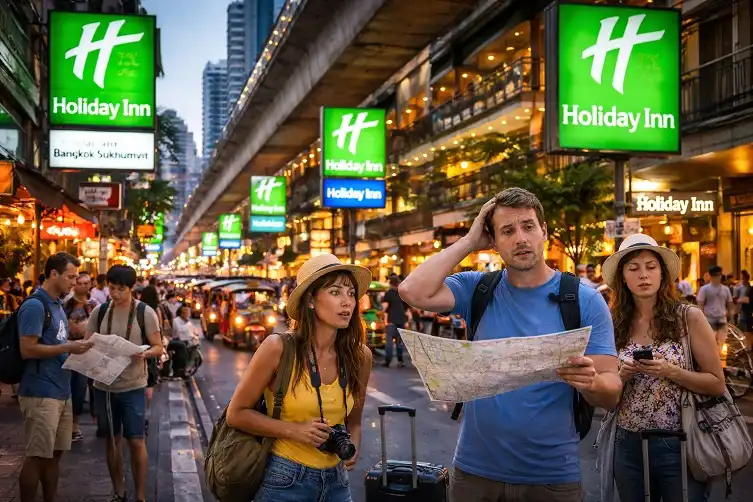
Image Credit: Bangkok Hotel News.
Local residents also report confusion when recommending hotels to visiting friends or business associates. The subtle differences in naming conventions and branding tiers are often lost on casual observers, leading to booking errors or mismatched expectations.
The Numbers Behind Bangkok’s Hotel Boom
The scale of Bangkok’s hospitality supply tells its own story. Out of the 156,402 total room keys currently registered, 62,750 belong to 4-star properties, representing the largest segment of the market. Five-star hotels account for 40,890 rooms, while 3-star hotels contribute 43,850 rooms and 2-star properties make up 8,912 rooms.
Geographically, the distribution reflects Bangkok’s commercial and tourism hotspots. Wattana District alone contains 37,040 keys, underscoring Sukhumvit’s dominance. Klong Toey follows with 20,250 keys, while Pathumwan hosts 17,300 keys. Bangrak and Sathorn districts add 13,920 and 10,130 keys respectively, highlighting how concentrated the hospitality industry has become within a relatively compact urban area.
Industry analysts say this concentration creates fierce competition but also raises questions about long-term sustainability, especially as operators continue to introduce new brands to capture niche segments such as wellness travelers, long-stay guests, and digital nomads.
Branding Complexity and the Traveler Experience
Hospitality experts argue that the proliferation of brands is both a strength and a weakness. On one hand, travelers benefit from more choices and competitive pricing. On the other, brand fatigue is becoming a genuine issue. A single corporate group may operate luxury, premium, lifestyle, and budget brands that appear almost interchangeable to the average guest.
The problem is amplified by digital booking platforms, where brand names dominate search results but fail to clearly communicate differences in service level, room size, or target audience. As a result, travelers increasingly rely on reviews and social media rather than brand loyalty alone.
Some operators have begun investing more heavily in distinct design concepts and localized experiences to differentiate their properties, but experts say the challenge will persist as long as expansion remains rapid.
A Market at a Turning Point
Bangkok’s hotel industry stands at a critical moment. The city’s extraordinary inventory demonstrates strong investor confidence and continued tourism potential, yet the rising complexity of the market could reshape how hotels position themselves in the years ahead. Clearer branding, stronger storytelling, and more transparent communication may become essential tools for winning traveler trust in an environment where choice has become both a blessing and a burden. With thousands of rooms concentrated under overlapping brand families, the real challenge may no longer be attracting guests, but helping them understand where they actually want to stay — and why.
For the latest on the hotel and hospitality market in Bangkok, keep on logging to Bangkok Hotel News.
Visit Also: