


Hotel News: Ascott’s latest global performance numbers are, by any reasonable industry measure, impressive. Signing 102 properties and roughly 19,000 units in a single year is no small feat, especially in a hospitality environment still wrestling with cost pressures, shifting travel behaviour, and increasingly cautious owners. From Singapore to Spain, from Taipei to Wellington, The Ascott Limited has clearly mastered the art of asset-light growth, franchise acceleration, and multi-brand expansion. Yet from a Bangkok hotel industry perspective, there is an uncomfortable contrast that cannot be ignored: while Ascott is loudly visible on the global stage, its individual properties in Thailand often feel curiously invisible in local media and consumer-facing communications. We seldom read of any promotions involving rooms, meeting facilities, food and beverage outlets or even their spas in local media or social media platforms. Do they have marketing and PR staff in Thailand or maybe they do not believe in marketing, PR and promotions and simply resign their fate to the OTAs or simply to their corporate website only. Brand awareness of its various brands and its individual properties among consumers are very low in many markets despite having so many properties.
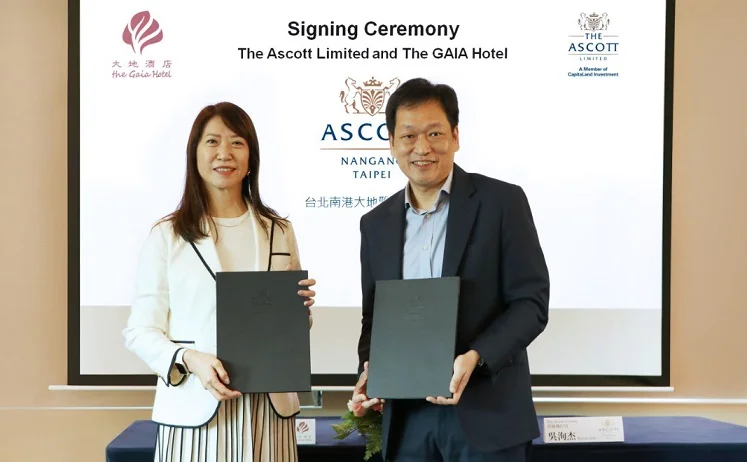
Image Credit: Ascott (Ascott marked its entry into Taipei with the signing of the 185-room Ascott Nangang Taipei)
The company’s 27 percent year-on-year growth in new signings reflects strong owner confidence and a well-oiled corporate development machine. It also reinforces Ascott’s positioning as one of Asia’s most aggressive and sophisticated hospitality operators, with more than 1,000 properties either operating or in the pipeline across over 40 countries. That said, for those of us watching from Thailand, the question is not whether Ascott is expanding successfully, but whether its achievements are being translated into meaningful, proactive marketing at the property level and good performance of these individual properties.
Global Growth That Commands Respect
Ascott’s 2025 expansion spanned more than 10 new cities across Asia Pacific and Europe, taking the group into locations such as Wellington, Taipei, and a variety of resort destinations including Phuket, Phu Quoc, and Langkawi. The company’s leadership has been clear about its priorities: higher-fee segments, faster conversions, franchising, and a diversified brand ecosystem that allows flexibility across market cycles.
This Hotel News report highlights a recurring local sentiment. While global announcements are polished and frequent, tangible, locally relevant storytelling around individual Thai properties is rarely seen in domestic or international media channels. Are these properties performing well? How are their occupancy levels and their average room revenues? How are their food and beverage outlets, meeting room and spa revenues doing? We never read anything about these let alone see any actual promotions about these properties in any local media.
From an investor standpoint, the numbers are reassuring. Ascott now has embedded income visibility that supports its ambition to exceed S$500 million in fees as pipeline projects come online. Its flex-hybrid operating model, combined with investment in loyalty platforms, technology, wellness, MICE, and branded residences, positions the group to ride multiple demand waves simultaneously.
Strategically, it is hard to fault.
Strategic City Entries and Flagship Statements The entry into Taipei with Ascott Nangang Taipei is a textbook example of smart positioning. Located in a major mixed-use development within Nangang Software Park, the 185-room serviced residence benefits from strong corporate demand, excellent transport links, and proximity to key exhibition and convention infrastructure. Similarly, lyf’s debut in Wellington extends the brand’s social-living concept into New Zealand’s capital, targeting a blend of professionals, creatives, and longer-stay travellers seeking community-driven accommodation

Image Credit: Ascott
These moves demonstrate Ascott’s confidence in experience-led brands and transit-oriented developments. They also underscore the group’s ability to secure partners in competitive urban environments. From a global branding lens, these are exactly the kinds of signings that reinforce credibility and momentum.
Resorts and Branded Residences Drive Fee Growth
Leisure travel demand played a major role in Ascott’s 2025 performance, with 15 resort signings in destinations such as Phuket, Bali, Nha Trang, and Phu Quoc. The expansion of the resort portfolio to more than 50 properties globally aligns neatly with the ongoing shift toward longer stays, blended leisure-work trips, and lifestyle-driven travel decisions.
In Thailand, the addition of branded residences adjacent to resort properties, particularly near Patong Beach, reflects a broader regional trend. Buyers are increasingly drawn to branded living concepts that promise hotel-style services, rental yield potential, and brand assurance. Ascott’s ability to co-locate hotels and residences enhances operational efficiency and cross-marketing opportunities, at least on paper.
However, from a local observer’s perspective, one cannot help but wonder how many potential guests or buyers in Thailand are actually aware of these offerings without actively searching for them. There is a noticeable absence of consistent, visible property-level promotion in Thai media, lifestyle publications, or even mainstream digital platforms.
Franchising, Conversions, and Operational Speed
Franchise agreements accounted for more than a quarter of Ascott’s 2025 signings, reinforcing the asset-light strategy that investors favour. The growth of Quest, Citadines, Oakwood, and Somerset through franchising and conversions demonstrates operational agility. Conversions completed within months of signing highlight a capability many competitors struggle to match.

Image Credit: Ascott
From a technical and operational standpoint, Ascott’s execution deserves recognition. Owners seeking faster market entry and reduced risk clearly see value in the platform. Yet again, the critique from Thailand is not about capability, but actual property performance. Signing more properties does not automatically translate into individual property performance or market visibility unless it is actively and consistently communicated.
Brand Scale and Market Presence
Several of Ascott’s brands reached significant milestones in 2025. Citadines crossed the 200-property mark globally. Oakwood continued to appeal across business, leisure, and extended-stay segments. Collection brands expanded into Africa, Europe, and the Middle East, while the flagship Ascott brand grew to 87 properties worldwide.
These achievements reinforce Ascott’s status as a multi-brand powerhouse. But within Thailand, the brand story often feels diluted. Consumers are presented with a hotel name, but rarely with a compelling narrative about what differentiates that property, why it matters, or how it fits into their lifestyle choices.
Local Silence Raises Strategic Questions
In Thailand, industry insiders sometimes quietly question whether there are any marketing or marketing communications staff actively handling the promotion of individual Ascott properties, or assisting with room, meeting facilities, food and beverage or spa promotions. The lack of consistent visibility in local and international media creates the impression that marketing efforts are either centralized far from the market or heavily skewed toward corporate-level announcements.
For a country that thrives on domestic travel, regional meetings, weddings, dining experiences, and staycations, this silence feels like a missed opportunity. Global growth headlines may excite investors, but local demand is built through sustained, targeted storytelling and engagement.
A Measured Perspective on Success
To be clear, this is not a dismissal of Ascott’s accomplishments. Signing 102 properties in a single year is remarkable. Expanding into new cities, scaling multiple brands, and strengthening fee visibility reflects disciplined strategy and strong leadership. Many hospitality groups would envy such results.
At the same time, success at the global level does not automatically guarantee resonance at the local level. Thailand is a nuanced market where relationships, visibility, and familiarity matter. Individual hotels or serviced apartments do not thrive solely on annual property signings; they thrive when local and foreign audiences feel connected to them.
Looking Ahead with a Critical Eye
As Ascott continues its rapid expansion, there is an opportunity to recalibrate how success is communicated. Greater emphasis on local storytelling, proactive engagement with domestic media, and clearer promotion of individual properties could significantly enhance brand equity on the ground. The infrastructure, brands, and operational capabilities are already in place. What appears to be missing is a consistent marketing and PR efforts.
If Ascott can bridge this gap, its individual properties could benefit just as much as its global balance sheet. Until then, the contrast between global acclaim and local quietness will remain a talking point among Bangkok’s hotel industry watchers, not out of hostility, but out of genuine curiosity and cautious skepticism.
For more on Ascott Limited and their properties, visit: https://www.discoverasr.com/en
For the latest on service apartments in Bangkok and beyond, keep on logging to Bangkok Hotel News.