


Hotel News: Vietnam is rapidly emerging as one of Asia’s most competitive tourism markets, and the shift is being felt sharply across the regional hotel industry. New data and executive insights now suggest that Vietnam’s accelerating infrastructure development, particularly in airports and hotels, is allowing it to close long-standing gaps with Thailand and, in several key areas, move decisively ahead.
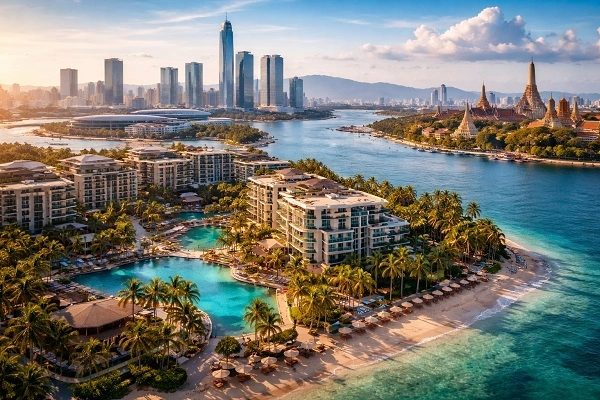
Image Credit: Bangkok Hotel News
For hotel operators and investors watching regional performance, the numbers tell a compelling story. Vietnam’s tourism momentum has been building steadily over the past decade, driven by coordinated planning, aggressive infrastructure investment, and pricing strategies that appeal to both mass-market and premium travelers.
Visitor Numbers Reveal Diverging Paths
Vietnam recorded a historic milestone in 2025, welcoming 21.2 million foreign arrivals, a strong 20.4% increase from the previous year. This growth has been fueled largely by rising arrivals from China and Japan, two of Asia’s most important outbound travel markets.
Thailand, long regarded as Southeast Asia’s tourism powerhouse, experienced a notable reversal. International arrivals declined by 7.2% to 32.9 million, marking the first annual drop outside the Covid period in more than a decade. While Thailand still attracts higher absolute visitor numbers, the direction of travel has raised concerns among hotel executives and tourism planners alike.
This Hotel News report highlights a critical issue: growth momentum often matters more than size, particularly in an industry where future investment follows confidence and clear strategy.
Hotel Supply Becomes a Strategic Advantage
Accommodation capacity has become one of Vietnam’s strongest competitive levers. The country now boasts approximately 782,000 hotel rooms spread across 38,520 registered properties. This figure exceeds Thailand’s estimated 706,300 rooms, signaling a significant shift in regional supply leadership.

Image Credit: Bangkok Hotel News
Equally important is what lies ahead. Vietnam has a substantial pipeline of hotels under development, ranging from international luxury brands to mid-scale and lifestyle properties. This expansion is aligned closely with airport growth and destination planning, ensuring that new supply is matched with access and demand.
Pricing Power and Cost Efficiency
Vietnam’s pricing structure further strengthens its appeal. Average room rates are around 24% lower than those in Thailand, supported by lower labor and food costs and the continued expansion of low-cost airline networks.
In major Vietnamese cities, average daily room rates stand at approximately US$110, compared with US$133 in Bangkok. Resort destinations show an even wider gap, with Vietnamese resort room rates averaging US$115 versus around US$185 in popular Thai destinations such as Phuket. In the luxury segment, Vietnam maintains an advantage, with room rates typically US$50 to US$75 lower than comparable Thai markets.
Airports Driving the Next Growth Cycle
Infrastructure development is widely seen as the decisive factor behind Vietnam’s rise. Tan Son Nhat International Airport in Ho Chi Minh City opened its new T3 terminal last year, adding capacity for 20 million passengers annually and handling around 7,000 passengers per hour.
Looking ahead, Long Thanh International Airport, located 40 kilometers from Tan Son Nhat, is expected to begin operations in mid-2026, positioning southern Vietnam as a major regional aviation hub. On the resort front, Phu Quoc International Airport is undergoing a comprehensive upgrade designed to place it among the most advanced airports in the region.

Image Credit: Bangkok Hotel News
Beyond Leisure: Medical and Wellness Tourism
Vietnam’s ambitions extend well beyond leisure travel. Both the government and private sector are investing heavily in medical tourism, with mega hospitals and medical cities under development. The wellness sector is also expanding rapidly, supported by foreign talent recruitment, international healthcare professionals, and specialized doctors brought in to raise standards and global credibility.
Why This Matters for Regional Hotels
The contrast between Vietnam’s coordinated approach and Thailand’s more fragmented challenges has become increasingly apparent to hotel executives. Vietnam’s progress underscores how long-term planning, infrastructure alignment, and cost competitiveness can reshape tourism leadership, even against more established destinations.
For Bangkok’s hotel sector and Thailand’s wider hospitality industry, the message is clear. Competition is intensifying, and future success will depend on collaboration, transparency, and decisive reforms rather than reputation alone. The regional hotels race is no longer about legacy; it is about execution, adaptability, and unified vision, with Vietnam setting a pace that others can no longer afford to ignore.
References:
https://www.mordorintelligence.com/industry-reports/hospitality-industry-in-vietnam
https://www.technavio.com/report/hotel-market-in-vietnam-industry-analysis
https://www.jll.com/en-sea/guides/vietnam-hotel-investment-guide-2025
https://vir.com.vn/streamlined-administration-boosts-vietnams-hotel-investment-prospects-141197.html
https://www.aspectureglobal.com/post/vietnam-hospitality-and-tourism-industry-overview-2025
For the latest on the hotel industry in the Asian region, keep on logging to Bangkok Hotel News.