


Bangkok Hotel News: A Changing Landscape in Bangkok’s Hospitality Scene
Over the past five years, Sukhumvit has witnessed an extraordinary transformation in its hospitality landscape. The skyline is now dotted with mid-tier and upper-scale hotels carrying global brand names such as Holiday Inn, Novotel, Hilton, Radisson, Wyndham, and Hyatt. Yet, behind many of these familiar names lies a new generation of Thai-Punjabi owners who have moved from tailoring into the world of franchised hospitality. Originally known for their tailoring businesses and fabric trading during the post-war decades, many of these families accumulated vast land banks across prime Sukhumvit corridors.

Rapid franchising of international brands by Thai-Punjabi hotel owners has led to a wave of poorly maintained “Wynorrific” hotels across Sukhumvit.
Image Credit: AI-Generated
Today, they are leveraging these assets by entering hotel franchising agreements—effectively renting out the brand power of international chains.
However, what was once seen as an exciting symbol of progress and modernization has now turned into a cautionary tale. This Bangkok Hotel News report finds that many of these franchised establishments have drifted far from the operational standards the global brands are known for. While corporate agreements often stipulate brand guidelines, maintenance schedules, and quality benchmarks, some local owners have been quietly cutting corners, driven by profit margins and cost-saving tactics.
The Rise of Third-Party Management and Franchise Fatigue
International hospitality giants have shifted strategies in recent years, increasingly opting for franchising and third-party management over full ownership. This business model allows them to expand brand presence rapidly without heavy capital investments. Unfortunately, this has also opened the door for inconsistent execution. In Sukhumvit, where land values are high and competition fierce, many local operators under these franchise banners are prioritizing savings over service.
Several insiders reveal that in some properties, international management oversight is minimal, leading to unchecked decision-making by local owners. While the sign outside may proudly read an international hotel brandname, what guests experience inside often feels worlds apart from the brand’s global promise.
Cutting Corners and Tarnishing Reputations
Reports from former staff and frequent guests paint a worrying picture. Some hotels have adopted shocking cost-cutting measures—recycling buffet leftovers, freezing unconsumed food, and reusing it in subsequent days. Housekeeping departments have been drastically reduced, leaving entire floors unattended for hours. Guest rooms often suffer from inconsistent cleaning standards, while corridors reek of poor sanitation and neglect.
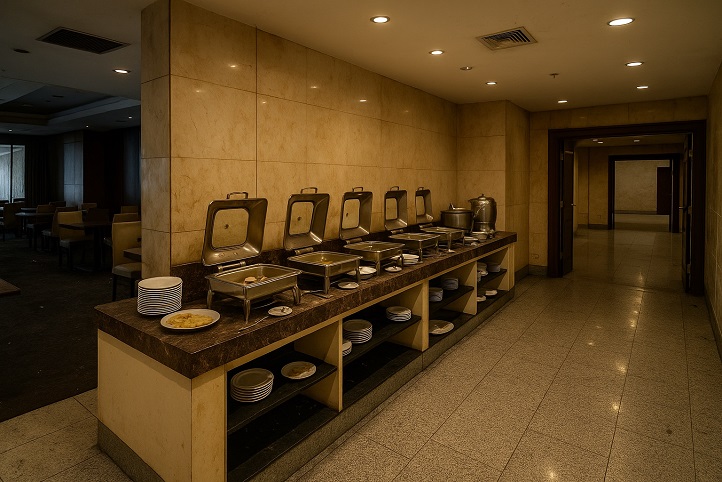
Wynorrific hotels and their buffest that make you sick!
Image Credit: AI-Generated
At one franchised brandname property on the main road between Soi Asoke and Thonglor, the situation has become symbolic of this wider malaise. Guests describe the foyer and ballroom areas as “smelling of urine,” while public restrooms are rarely cleaned. The café’s glass windows are streaked with grime, and the floor beneath the buffet counters often hides a collection of dead insects. Even more distressing are guest complaints of stomach upsets after dining at the property’s buffet, where hygiene standards appear to have collapsed entirely. Staff, many of whom are paid below industry norms, struggle to communicate effectively in English and lack basic hospitality training. Many of these hotels also employ Indian food and beverage directors or Indian chefs.
Brand Names Without Brand Standards
Industry observers warn that this unchecked franchising spree could tarnish the reputations of major hotel brands in Thailand. While international headquarters rely on periodic audits, enforcement is often limited by franchise contracts and local business politics.
Tourists, meanwhile, are left confused. They book expecting a certain level of quality promised by a global chain, only to find themselves in poorly maintained, badly managed properties that feel more like budget inns than four-star establishments. The mismatch between brand promise and guest experience has led some frequent travelers to coin a term that now circulates quietly among local expats and travel insiders—“Wynorrific hotels”, looking impressive with a brand name but a horrid experience or stay.
Many of these hotels also employ low grade Caucasian-looking general managers whose jobs are just to generate fake trip advisor reviews etc but not to maintain hotel standards!
A Cautionary Tale for the Hospitality Industry
The boom in Wynorrific hotels across Sukhumvit serves as both a business case study and a warning. Rapid franchising without stringent oversight risks damaging the very brands that once symbolized international excellence. For owners, the rush to join the global hospitality club has brought short-term profit, but at the cost of long-term reputation. The essence of true hospitality lies not in the name on the façade but in the consistency, cleanliness, and sincerity of service that defines guest experience. Unless franchisors and local owners reinstate operational integrity and prioritize training, Bangkok’s hotel corridor could soon find its glittering logos masking a deeper decay.
Bangkok Hotel News will be publishing a list of some of these Thai-Punjabi owned hotels in Bangkok, Chiang Mai, Phuket etc on third party site (to evade any legal issues) so that travelers can be warned of these “garbage” properties.
For the latest news, keep on logging to Bangkok Hotel News.