


Bangkok Hotel News: A Sweeping Financial Clampdown
Thailand is reeling from one of the most controversial financial operations in its recent history. The Bank of Thailand (BOT), in its aggressive campaign to dismantle scam and fraud networks, has frozen millions of accounts nationwide. Officials insist the crackdown is focused on “mule accounts” used for laundering illicit funds, but the net has captured far more than intended. Millions of ordinary Thais, along with thousands of expatriates, have found themselves locked out of their own money with no warning and little recourse.
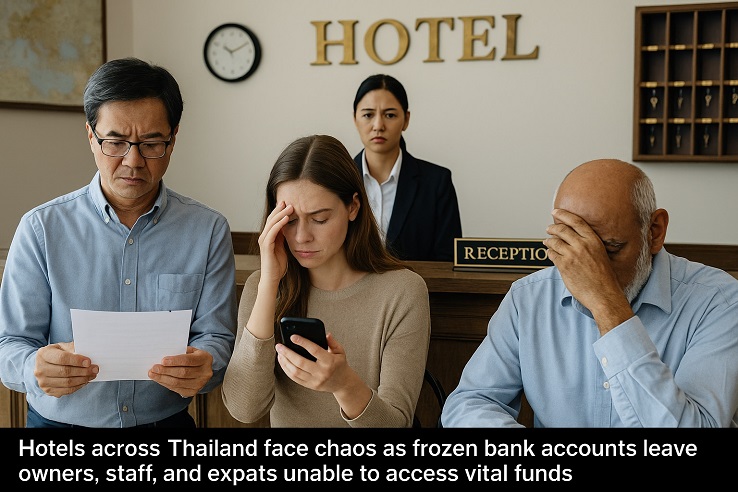
Hotels across Thailand face chaos as frozen bank accounts leave owners, staff, and expats unable to access vital funds
Image Credit: AI-Generated
For hotels, particularly small and mid-size establishments, the freeze has been devastating. Across Bangkok, Pattaya, Phuket, Chiang Mai, and Hua Hin, hoteliers report that many properties have been impacted, leaving both owners and employees struggling to cover salaries, food, transportation, and even medical bills. In this Bangkok Hotel News report, insiders estimate that at least 70,000 hospitality workers have been directly affected, with many unable to access even a fraction of their savings.
The Justification and Its Costs
Authorities argue the freeze is necessary. Scam losses in Thailand topped 6 billion baht (about $160 million USD) in the second quarter of 2025 alone, with 24,500 cases averaging over 114,000 baht per victim. To counter this, BOT has immobilized nearly 3 million accounts, citing connections to 177,000 suspected mule accounts, while also imposing daily transfer limits of between 50,000 and 200,000 baht. BOT Governor Sethaput Suthiwartnarueput has defended the measures as “temporary and targeted.”
But the reality has been anything but temporary for many families and businesses. The process to prove innocence is a labyrinth of police clearances, affidavits, and repeated bank visits. Victims recount weeks of delays, unresponsive hotlines, and inconsistent documentation demands. For hoteliers, payroll deadlines have passed unmet, suppliers remain unpaid, and bookings are being cancelled because guests and managers alike cannot complete transactions smoothly.
Some claim that it is not just 3 million bank accounts that has been frozen but much more and that hundreds of thousands of bank accounts are being frozen each day still.
Hotels Strangled by the Freeze
For small and mid-size hotels, which form the backbone of Thailand’s hospitality sector, the impact has been catastrophic. Many of these establishments operate on razor-thin margins, relying on steady digital cash flows to cover day-to-day expenses. With accounts frozen, over 2,300 hotels have had to delay staff salaries, defer rent payments, and halt essential maintenance.
Housekeepers, receptionists, drivers, and cooks are suddenly unable to pay for food, rent, and transportation. Reports indicate that at least 70 percent of employees in affected hotels have dipped into personal emergency cash reserves, while others are resorting to high-interest loans from informal lenders. Entire families are left vulnerable, with some hotel staff reporting they can no longer afford necessary medicines for their children or elderly parents.
Larger hotel chains, with more diverse financial structures, have weathered the crisis more effectively. But boutique hotels, family-run guesthouses, and mid-tier resorts—representing the majority of Thailand’s hospitality inventory—are gasping for survival. Many fear permanent closures if funds remain inaccessible through the high tourist season.
Expatriates Struggling in Silence
The freeze has also rattled Thailand’s expatriate community. Retirees, digital nomads, and long-term residents have been swept into the crackdown. An estimated 140,000 expats have had their accounts frozen in the past two months. For retirees, pensions that are usually deposited directly into Thai accounts are now locked in limbo. Digital nomads, who rely on flexible freelance income, are unable to receive client payments.
The effects have rippled through Thailand’s hospitality industry in unexpected ways. With thousands of foreigners suddenly strapped for cash, hotel restaurants and bars have seen a sharp decline in patronage. Managers in Chiang Mai, Pattaya, and Hua Hin report that expat footfall is down by as much as 40 percent since August. Regular customers, who once dined weekly in hotel venues, now admit they cannot afford to spend because their accounts remain inaccessible.
This has created a vicious cycle. Hotels are already struggling to meet expenses due to frozen business accounts, and now they are facing falling revenues as one of their most dependable customer bases—the expat community—pulls back on spending.
Many expats have also complained that many local Thai banks have been very unhelpful and rude with many complaining about Bangkok Bank. There is a now a movement among expats to close their Bangkok Bank accounts and shift their banking elsewhere and also for businesses to boycott and refuse any payments coming from Bangkok Bank so that these account holders will also close their bank accounts with Bangkok bank and shift elsewhere. Many are also calling for a boycott of any businesses or brands that are linked to Bangkok Bank etc
Unequal Enforcement Allegations
While ordinary people endure financial chaos, suspicions of selective enforcement have fueled public anger. Social media has erupted with accusations that elite families, political figures, and large conglomerates such as CP Group and Central Group have been spared scrutiny. Critics argue that the system disproportionately punishes the vulnerable while letting well-connected players glide by untouched.
Hotel operators have voiced frustration that while their modest accounts are frozen for questionable “patterns,” the multimillion-baht transfers of political insiders appear unexamined. “If a hotel pays suppliers in cash after being frozen, it is flagged for suspicious activity. But when conglomerates move billions, no one asks questions,” one Bangkok boutique hotel owner complained.
Rise of Parallel Economies
As frustration grows, some hotel operators and expatriates are experimenting with workarounds. Cash-only transactions are on the rise, particularly in smaller tourist hubs. In Phuket and Chiang Mai, a few boutique hotels now encourage guests to settle bills in cash, while others are exploring cryptocurrency payments to bypass traditional banks.
Yet, these solutions are risky. Cash hoarding raises security concerns and could worsen inflation, while crypto transactions remain legally ambiguous and vulnerable to scams. Financial experts warn that the longer the freeze continues, the more Thailand risks fragmenting into parallel economies where trust in traditional banks erodes irreparably.
Employees and Guests Caught in the Middle
The most visible victims remain the everyday hotel employees and guests. Workers are trapped in uncertainty, unable to access funds for transport to work or to cover simple living costs. Some report skipping meals to save money. Guests, meanwhile, complain of disrupted stays: refunds cannot be processed, card payments are delayed, and online bookings sometimes fail altogether.
Travelers who chose Thailand for its convenience now face mounting frustrations. Online forums and review sites are beginning to reflect this sentiment, with complaints about “payment nightmares” appearing alongside standard travel reviews. Industry insiders fear this could tarnish Thailand’s reputation as a tourist-friendly destination, just as it seeks to strengthen its post-pandemic rebound.
A Sector on the Brink
The banking freeze has underscored just how vulnerable Thailand’s hotel sector is to financial shocks. Unlike multinational chains, most hotels in Thailand are deeply intertwined with local communities, employing tens of thousands and sustaining local supply chains. The freeze has disrupted not only hotel operations but also the broader ecosystem of taxi drivers, tour guides, and street vendors who depend on hotel traffic.
Unless swift reforms are introduced, the crisis could scar Thailand’s hospitality sector for years. Some hoteliers predict that hundreds of small and mid-size establishments may shutter permanently by year’s end, erasing jobs and livelihoods. The longer expats remain unable to access funds, the weaker hotel revenues will become, creating an economic tailspin that the BOT may struggle to reverse.
Final Thoughts
Thailand’s banking freeze may have been conceived as a necessary safeguard against rising scams, but its execution has revealed systemic flaws that are shaking public trust. By indiscriminately freezing millions of accounts, the BOT has unleashed unintended chaos on hotels, employees, expatriates, and local communities. Over 2,300 hotels and nearly 95,000 employees are already bearing the brunt of this policy. Meanwhile, an estimated 120,000 expatriates—key patrons of hotel restaurants and bars—have been sidelined financially, amplifying the strain on a sector that forms the backbone of Thailand’s tourism economy.
If reforms are not urgently implemented, the damage may extend beyond temporary hardship to permanent closures, reputational harm, and a chilling effect on future investment. A nation that prides itself on hospitality risks eroding both domestic confidence and global appeal. For now, the question lingers: will the banking freeze truly dismantle scam networks, or will it dismantle the very industries and communities it was meant to protect?
Meanwhile warnings are circulating around the world for retirees and digital nomads to avoid Thailand and also for those planning to invest in Thailand or buy properties it is unsafe as the governments can go anything or changes policies overnight
Media References:
https://thethaiger.com/news/national/bank-of-thailand-tackles-mule-account-freeze-impact
https://www.bangkokpost.com/thailand/general/3104288/more-people-may-suffer-frozen-bank-accounts-central-bank
https://www.reddit.com/r/Bangkok/comments/1n5qjcy/bangkok_bank_account_crackdown_a_researched/
https://www.nationthailand.com/news/general/40055395
https://www.facebook.com/groups/lifeinhuahin/posts/2262789167512017
https://fosrlaw.com/2025/thailand-visa-crackdown-2025/
https://www.thaienquirer.com/57752/bot-freezes-3-million-accounts-sets-daily-transfer-limits-of-50000-200000-baht-to-curb-6-billion-baht-scam-losses
https://www.youtube.com/watch?v=ocjl_T8iJIk
https://portail-asie.com/en/bangkok-bank-account-frozen-in-thailand
For the latest on Thai banks freezing bank accounts, keep on logging to Bangkok Hotel News.