


Bangkok Hotel Technology News: The Beginning of the End for Hotel Websites
For years, hotel websites were seen as the central hub for branding, guest engagement, and direct bookings. But with the rise of advanced artificial intelligence systems, that era is rapidly drawing to a close. AI-powered search engines and agentic travel bots are reshaping the very foundation of online hospitality. Unlike human users who need visual design, menus, and booking forms, AI agents require only structured data and direct system access. This Bangkok Hotel Technology News report highlights how these breakthroughs will soon render traditional hotel websites unnecessary.
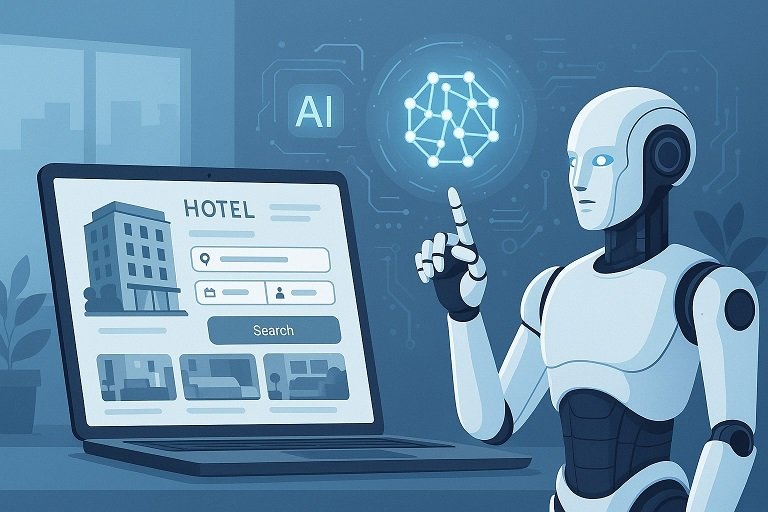
AI is already making real-estate websites obsolete
Image Credit: AI-Generated
How AI Search Engines Are Dismantling Traditional Search
One of the most striking developments comes from how AI search platforms now pull information. Studies reveal that only about 13 percent of AI-generated answers about hotels are drawn from actual hotel websites. The remaining 87 percent is compiled from publicly available sources, online travel agencies (OTAs), global distribution systems, proprietary databases and news sites. That means most of the content hotels have painstakingly built into their websites—descriptions of rooms, amenities, policies, and service features—are already redundant in the AI era.
When guests ask their personal AI assistant to find accommodation, the system no longer needs to crawl or display hotel websites. Instead, it retrieves consolidated data instantly, bypassing the traditional browsing stage.
The Rise of Agentic AI
Agentic AI is a transformative new layer of technology that doesn’t simply answer queries, but acts as a decision-maker and executor. Personal AI agents are now able to:
-Search hotels and compare options
-Access availability, rates, and inventory directly via APIs
-Finalize bookings without ever visiting a hotel’s site
These AI agents act like digital travel concierges, combining rate comparison, itinerary planning, and booking into one seamless process. They achieve this by connecting directly to hotel property management systems (PMS), central reservation systems (CRS), or through middleware such as the Model Context Protocol (MCP). The result is a complete bypass of traditional hotel web platforms.
Direct Connectivity Will Replace Visual Interfaces
The new AI-driven distribution model means that hotels must rethink how they share data. Instead of publishing content for human eyes on websites, they will need to provide machine-readable data via open APIs. AI systems require structured, consistent, and real-time information that can be instantly accessed and verified. For hoteliers, this means:
-Building API-first infrastructures
-Maintaining real-time ARI (availability, rates, inventory) data feeds
-Developing hotel-owned AI agents that can “handshake” directly with traveler AI systems
If hotels fail to provide their own AI agents, OTAs will gladly step in. That creates a scenario where AI platforms default to OTA data, further eroding direct booking channels.
Why Websites Cannot Compete with AI Efficiency
Hotel websites were designed to influence human decision-making with visuals, storytelling, and brand narratives. But AI agents are not swayed by images or poetic language. They operate on raw data, speed, and accuracy. For travelers, the benefits are clear:
-Personalized recommendations based on previous travel habits
-Faster comparisons across thousands of properties
-Transparent price evaluations without scrolling through multiple websites
In this environment, hotel websites lose their relevance. The efficiency and personalization of AI will always outperform manual browsing.
The OTA and AI Power Grab
Online travel agencies have historically dominated the booking funnel by consolidating inventory and offering price transparency. But AI changes the balance even further. AI agents already have the ability to connect with OTA-owned APIs, making OTAs the default source of truth in the AI travel ecosystem. Unless hotels invest in their own AI connectivity and direct integrations, they risk becoming invisible to the most powerful booking channel of the future.
The Illusion of Brand Storytelling
Some industry voices argue that hotel websites will remain critical for brand storytelling, identity, and emotional engagement. While this may hold true for luxury and boutique hotels targeting niche audiences, even these properties will struggle to stay relevant when AI becomes the first point of interaction. Travelers may still seek out visuals, but they will do so only after their AI agent has already shortlisted a handful of properties. By the time they arrive on a hotel website, most of the decision-making has already been automated.
From Web Pages to Data Warehouses
As the industry shifts, the future role of hotel websites will not be about visual engagement but about serving as back-end data warehouses. Instead of polished booking engines and sleek design, the most valuable websites will be those structured for AI optimization—clean APIs, standardized data, and seamless connectivity. In this sense, the traditional concept of a “hotel website” ceases to exist as a guest-facing product. Instead, it becomes an invisible infrastructure layer.
The New Booking Journey Powered by AI
The emerging booking journey is entirely different from the one hotels have relied upon for two decades:
-A traveler instructs their AI assistant to find a hotel.
-The assistant considers personal preferences, budget, location, and even loyalty memberships.
-It fetches ARI data directly from connected systems.
-It books the hotel instantly, without opening a browser tab or visiting a single website.
-This streamlined, machine-to-machine journey eliminates the need for traditional front-end web pages.
Why the Shift Is Inevitable
Technology adoption in hospitality often comes with skepticism, but this time the shift is unavoidable. The rise of AI is not a minor evolution—it is a platform shift.
We are moving from an internet designed for humans to one designed for machines. Just as smartphones once redefined how people consumed content, AI will redefine how travel is planned and booked. Hotels that cling to outdated website models will find themselves increasingly cut off from the most influential booking pathways.
Final Thoughts
The disappearance of hotel websites is no longer a speculative debate—it is a technical inevitability. AI search engines already bypass the majority of hotel web content. Agentic AI platforms are now capable of planning entire trips and executing bookings without ever referencing a traditional website. APIs, middleware, and direct connectivity are becoming the dominant structures of travel distribution.
Yes, hotel websites may linger for a while, serving niche purposes like brand storytelling or visual engagement. But for the mainstream traveler, the journey will begin and end with AI. Hotels that fail to prepare will lose ground to OTAs and third-party agents who are already building the infrastructures to dominate this new era. For the industry, the question is not whether AI will make hotel websites obsolete, but how quickly the transition will unfold. In many respects, it has already begun.
For hotels needing support in making the shift to AI integration, contact us at the numbers or emails found the contact section for a free consultation. We have a total of 28 top AI engineers from around the world at our AI lab. For the latest Bangkok Hotel Technology News, keep on logging to Bangkok Hotel News.